


Ethereum turned money into software, but it also turned financial activity into a permanent public record. Every swap, every transfer, every lending move, and every bridge is visible forever. Even if your name is not attached to your wallet, your behavior can still be traced, clustered, and analyzed. For many people, that reality feels uncomfortable. For traders, it can be expensive. For teams and DAOs, it can be risky. That is why the idea that Railgun works on private DeFi on Ethereum is gaining attention: it aims to bring practical privacy into everyday DeFi usage without breaking the core benefits of Ethereum.
Privacy in DeFi is not just about “hiding.” It is about control. It is about being able to use a public blockchain without broadcasting your whole strategy, your savings, your payroll, or your business relationships to the world. The promise of private DeFi on Ethereum is simple: you can still use smart contracts, still benefit from deep liquidity, and still build on open infrastructure, but you do not need to expose everything along the way.
Railgun approaches this problem using zero-knowledge proofs, specifically zk-SNARKs, to validate transactions without revealing sensitive details. In normal Ethereum transactions, the network needs to see the inputs and outputs. In a privacy system, the network only needs to see proof that the action is valid. That is the heart of why Railgun works on private DeFi on Ethereum: it aims to keep DeFi composable while making your balances and activity far less readable to outsiders.
In this article, we’ll walk through what Railgun is, why privacy matters in Ethereum DeFi, how Railgun’s shielding model works, how private DeFi interactions can happen, and what practical benefits and trade-offs you should understand. The goal is simple: clear explanation, smooth flow, and good readability—basically, “readability good ho jaye.”
Why privacy matters in DeFi on Ethereum
Ethereum is transparent by design. That transparency is valuable for audits and trust, but it also creates a surveillance economy. On-chain analytics firms, bots, and competitors can observe almost everything. A single wallet can reveal a long-term profile: what tokens you hold, when you buy, when you panic sell, what protocols you prefer, and which addresses you interact with.
This creates real-world problems. If you are a trader, your moves can be copied. If you are swapping a large amount, bots can target you with front-running and sandwich attacks. If you are using lending protocols, observers can estimate liquidation levels. If you manage a DAO treasury, outsiders can track vendors, salaries, and future moves.
Privacy is also basic financial dignity. Many people simply do not want their income, spending, and savings visible to anyone with a block explorer. Traditional finance is not “perfect,” but it does include privacy by default. Ethereum flips that default, and DeFi users are now asking for a better balance.
That is the environment where Railgun works on private DeFi on Ethereum becomes a practical solution rather than a niche idea.
What Railgun is and what it is trying to solve
Railgun is a privacy system designed for Ethereum and other EVM chains that focuses on DeFi usability. The key idea is not just private transfers, but private interaction with DeFi applications. It aims to create a layer where funds can be placed into a shielded state and then used in a way that does not expose the user’s full on-chain footprint.
Think of it like this: in normal DeFi, your wallet is a glass box. Railgun aims to provide a “shielded” box where the public chain can still verify that you are not cheating, but it cannot easily see what is inside.
This distinction matters. Many privacy tools historically created isolated environments. You would enter privacy, do a private transfer, and then leave privacy to do anything useful. The moment you leave, your past becomes linkable again. Railgun’s focus is to make privacy compatible with DeFi actions so that Railgun works on private DeFi on Ethereum in a way that feels native, not separate.
How Railgun works on private DeFi on Ethereum
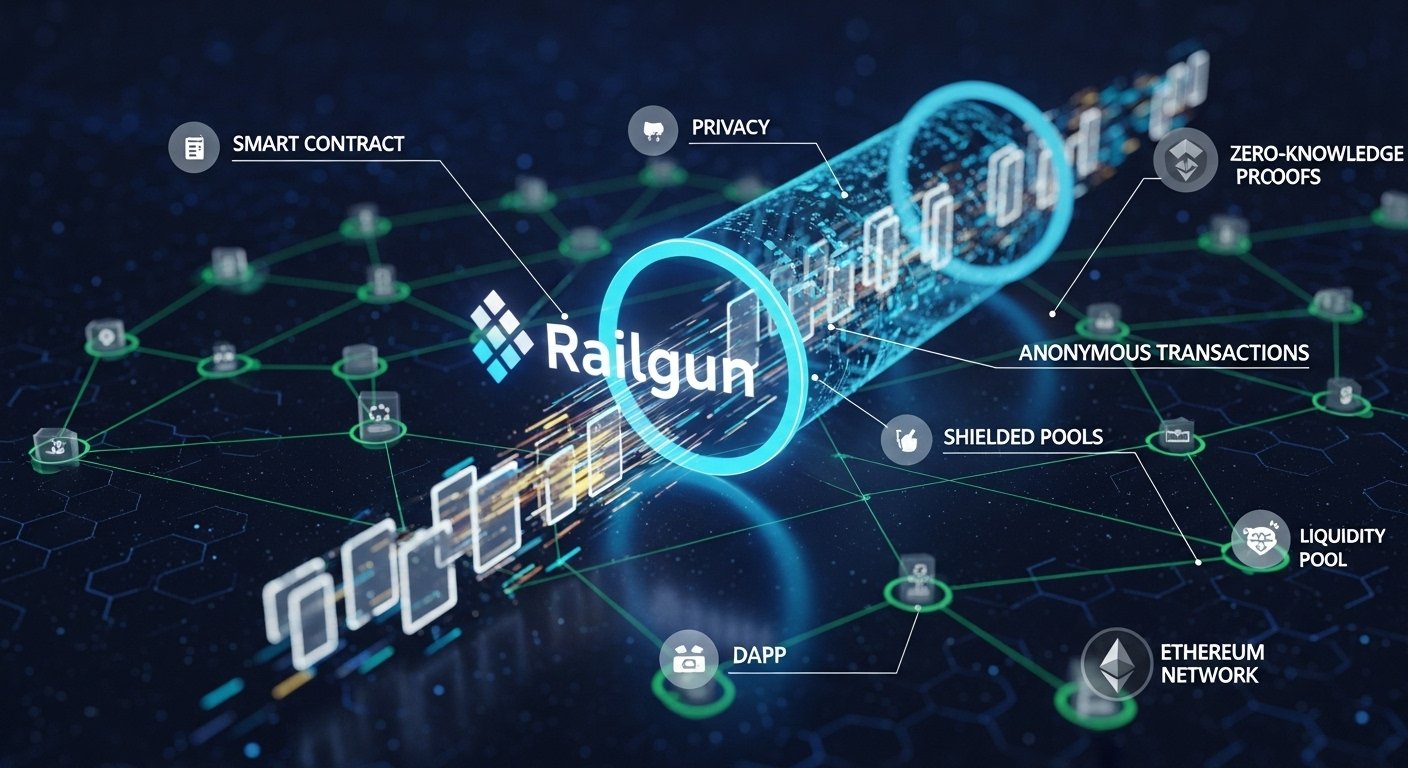
The clearest way to understand Railgun is to break it into three connected parts: shielding assets, proving transactions privately, and interacting with DeFi while staying shielded.
Shielding assets: the privacy starting point
Shielding is the step where you move tokens into Railgun’s privacy system. In a normal wallet, your ERC-20 balance is visible under your address. When you shield assets, you move them into a structure where your personal balance is represented privately, not as a simple public number tied to your public wallet identity.
This is important because privacy needs a clean boundary. If your funds remain fully exposed in your public wallet, every DeFi step becomes easy to track. Shielding creates a new privacy context.
This is why many people say Railgun works on private DeFi on Ethereum: the system starts by changing how balances are represented and observed.
Zero-knowledge proofs: privacy with verification
Ethereum cannot accept “trust me” as an argument. Any private DeFi system must still provide correctness guarantees. Railgun relies on zero-knowledge cryptography so that you can prove statements like these without revealing underlying details:
- You own the funds you are spending.
- Your spending does not exceed your balance.
- The transaction follows the protocol rules.
- The state update is valid and consistent.
A zk-SNARK proof lets the network verify those claims without learning the private inputs. In other words, the chain sees proof, not your secrets. That is the core mechanism behind why Railgun works on private DeFi on Ethereum.
Shielded transfers: private movement of value
After shielding, you can move value in a shielded way. Instead of a typical “Address A sends 1 ETH to Address B” record that is easy to read, the system aims to make the relationship between sender and recipient much harder to connect. The transaction still happens on-chain, but the details are protected by cryptography.
This matters for everyday use. Paying a contractor, moving funds between your own accounts, or sending money to family should not automatically create a public trail that anyone can follow. Shielded transfers are a foundation, but the bigger story is DeFi interactions.
Private DeFi interactions: the composability goal
Here is the big point. DeFi is powerful because everything connects: DEXs, lending, yield strategies, aggregators, and vaults. If privacy breaks that composability, people will not use it. A privacy system that forces you to leave DeFi is not a DeFi privacy system.
Railgun aims to support private interaction with DeFi contracts so that you can still do meaningful actions while keeping your wallet history and balances protected. When people repeat the phrase Railgun works on private DeFi on Ethereum, they are usually referring to this: the idea that you can swap, route, and interact with DeFi while staying in a shielded context, rather than “going public” at every step.
What “private DeFi” actually means in daily usage
It helps to define private DeFi in practical terms. Private DeFi does not mean the blockchain becomes invisible. Ethereum is still public. The smart contracts still execute publicly. What changes is the visibility of user-specific details and linkages.
In normal DeFi, observers can often follow a clean line: deposit came from this wallet, swap happened here, withdrawal went to that wallet, and now the new holdings are visible. In private DeFi, the goal is to break those easy linkages while keeping the validity guarantees.
So when you say Railgun works on private DeFi on Ethereum, you are not claiming that Ethereum becomes private. You are saying that the user’s financial story becomes much harder to reconstruct from public data.
Why traders care: MEV, copy trading, and strategy leakage
DeFi traders deal with a uniquely aggressive environment. Bots watch mempools and order flow. Large swaps can invite MEV extraction. Even when you set slippage protection, your intent can still be exploited.
Privacy changes the economics of this environment. If your exact route, token amounts, and wallet balances are not easy to read, you become a less obvious target. It does not eliminate MEV completely, but it reduces the information advantage that makes extraction easier.
This is a major reason Railgun works on private DeFi on Ethereum is a compelling narrative for active DeFi users. Privacy is not only personal; it is protective.
Why DAOs and teams care: treasury privacy and operational safety
DAO treasuries are public by default. That creates problems: competitors can track spending, attackers can analyze patterns, and governance participants can react to leaks in real time. Even simple vendor payments can reveal who is building what.
A privacy layer can let organizations move and use funds with less exposure. This can improve negotiation leverage, protect contractors, and reduce targeted threats. In a world where on-chain activity is often treated like public PR, privacy becomes a security tool.
That is another angle behind Railgun works on private DeFi on Ethereum: it supports real organizational workflows, not just individual curiosity.
Private Proofs and the trust conversation
Privacy tools face a constant tension. Users want privacy. Ecosystems worry about misuse. This is where concepts like selective assurance appear: proving something about your funds without revealing the private trail.
Railgun has discussed mechanisms like private proofs that aim to show funds are not connected to certain problematic sources while maintaining privacy. The important takeaway is not the politics; it is the architecture trend. Modern privacy is evolving from “pure hiding” toward “privacy plus proofs,” where you can optionally prove compliance-relevant properties without exposing your entire wallet history.
This is significant for adoption because it affects integrations. Wallets, interfaces, and services are more likely to support private DeFi when they can manage risk without forcing every user into full public exposure.
User experience: what using Railgun can feel like
Privacy tech often fails at the UX layer. If it is too complicated, people avoid it. Railgun-style systems typically introduce steps like shielding, generating proofs, and possibly using relayers. These steps add complexity compared to a standard swap.
However, privacy UX is improving. Many users are willing to accept slightly slower flows if they get meaningful protection in return. The key is that the privacy layer must feel integrated. If switching between public and private modes is smooth, then private DeFi becomes a habit rather than a one-time experiment.
This is why the phrase Railgun works on private DeFi on Ethereum matters as a usability statement. It implies that privacy is not a side quest. It is built into the DeFi journey.
Security and trade-offs you should understand
Privacy systems are powerful, but they are not free. You should understand the basic trade-offs so you can use them responsibly.
First, smart contract risk is real. Any on-chain system can have bugs. Privacy adds more complexity through cryptographic circuits and proof verification. That means audits, testing, and careful upgrades matter.
Second, proof generation can be heavy. Depending on implementation and device, generating zk proofs can take time and resources. UX tools can hide complexity, but the underlying computation still exists.
Third, privacy is not invincibility. Timing analysis, user mistakes, and off-chain leakage can still reduce privacy. If you shield funds and then immediately withdraw to a known identity exchange account in a predictable amount, you can still create linkable patterns. Privacy improves your position, but you still need good habits.
Even with these trade-offs, many users believe the benefits are worth it, especially as on-chain surveillance grows. That is why the claim Railgun works on private DeFi on Ethereum continues to attract interest: it offers a privacy path without abandoning Ethereum’s DeFi ecosystem.
Railgun in the broader privacy landscape
Ethereum privacy can be attempted in different ways. Some approaches try to hide IP and network identity. Some try to obfuscate transaction paths. Some build full privacy layers using zero-knowledge systems.
Railgun fits into the third category: ZK privacy with an emphasis on DeFi composability. The important point is that private DeFi is not one feature; it is a stack. You may need network privacy, wallet hygiene, and protocol-level privacy together for the strongest protection.
Still, protocol-level privacy is foundational because it changes what the chain itself reveals. That is why Railgun works on private DeFi on Ethereum is often framed as a major step toward everyday on-chain privacy.
The future of private DeFi on Ethereum
Private DeFi is becoming more relevant, not less. As Ethereum grows, analytics become more advanced. Bots become faster. Competition becomes sharper. This pushes users to demand better protection.
At the same time, zero-knowledge technology is maturing. ZK tools are becoming faster, more developer-friendly, and more integrated into wallets and dApps. That convergence suggests a future where private DeFi is not an exotic corner of crypto, but a normal mode of using Ethereum.
In that future, privacy becomes like HTTPS on the internet: once optional, then expected. The idea that Railgun works on private DeFi on Ethereum points toward that direction, where privacy is not suspicious—it is standard.
Conclusion
Ethereum’s transparency helped DeFi explode, but it also created a world where every user is permanently observable. That reality can harm traders, expose organizations, and remove basic financial privacy from ordinary people. Private DeFi is the response: a way to keep Ethereum’s composability and openness while protecting user-specific details and linkages.
Railgun’s approach centers on shielded balances and zero-knowledge proofs so that transactions can be validated without exposing sensitive information. This is the core reason people say Railgun works on private DeFi on Ethereum. It is not just about hiding transfers. It is about making privacy compatible with real DeFi actions, so you do not have to choose between usefulness and confidentiality.
Private DeFi on Ethereum is still evolving, and no system removes every risk. But as surveillance grows and ZK technology improves, privacy-first DeFi will likely become a normal expectation. Railgun is one of the projects pushing that idea forward, aiming to make privacy practical, composable, and usable for real on-chain life.
FAQs
Q: What does it mean that Railgun works on private DeFi on Ethereum?
It means Railgun is designed to let users use DeFi on Ethereum while keeping key details private, using zero-knowledge proofs so the chain can verify validity without seeing sensitive inputs.
Q: Is private DeFi on Ethereum the same as making Ethereum private?
No. Ethereum remains a public blockchain. Private DeFi focuses on hiding user-specific details and breaking easy linkages between actions, not hiding the existence of smart contract activity.
Q: Does privacy automatically protect me from MEV and sandwich attacks?
Privacy can reduce the information that bots rely on, but it does not guarantee zero MEV. Good trade settings, routing choices, and general DeFi hygiene still matter.
Q: What is shielding, and why is it important?
Shielding is moving assets into a privacy system so your usable balance is not simply a public ERC-20 number under your normal address. It creates the base for private activity.
Q: Can private DeFi be used by businesses and DAOs, not just individuals?
Yes. Treasury moves, vendor payments, and strategy execution can all benefit from reduced on-chain exposure. Privacy can improve operational security for organizations as well.
Also Read: DeFi Technologies Inc. Class Action Deadline Jan 30, 2026
