


Bitcoin has spent more than a decade teaching investors one recurring lesson: cycles matter. The familiar rhythm—rapid bull markets, euphoric peaks, punishing drawdowns, and slow recoveries—has made the Bitcoin four-year cycle feel almost like a law of nature. Many traders plan their entries around it. Many long-term investors use it to temper expectations. Entire market narratives have been built on the idea that Bitcoin’s halving-driven supply shocks help shape a repeating pattern.
But 2026 is creeping into focus, and the conversation is changing. Binance’s former CEO Changpeng Zhao, widely known as CZ, has publicly suggested that the historic four-year pattern may be losing its grip—and that a Bitcoin supercycle 2026 scenario is plausible. Reports covering CZ’s remarks describe a world where Bitcoin’s next major expansion doesn’t neatly end the way prior cycles did, potentially extending longer or behaving differently than the classic boom-and-bust cadence.
That’s a big claim, because “cycle break” talk usually shows up near market extremes, and it’s often wrong. Still, it’s worth taking seriously—especially now that Bitcoin is no longer a niche asset. The market structure has evolved. Institutional adoption is deeper. Regulation and macro liquidity matter more than ever. The presence of spot ETFs in major jurisdictions has shifted how capital enters and exits the market. And with Bitcoin’s global narrative continuing to mature, many investors are asking a sharper question: is the Bitcoin four-year cycle about to break, and could BTC really enter a monster supercycle in 2026?
In this article, we’ll unpack what the Bitcoin four-year cycle actually is, why it formed, what could disrupt it, and what CZ’s thesis really implies. We’ll also explore catalysts, risks, and the practical signals that may help investors judge whether the Bitcoin supercycle 2026 idea is a meaningful regime shift—or just another catchy narrative.
Understanding the Bitcoin four-year cycle and why it became “the rule”
The Bitcoin four-year cycle is commonly linked to Bitcoin’s halving schedule, which reduces the new supply of BTC entering circulation roughly every four years. Historically, halvings have tended to precede major bull markets, followed by overheated peaks and sharp retracements. Because the halving is programmatic and predictable, the broader market built expectations around it—expectations that often became self-reinforcing.
A key reason the Bitcoin four-year cycle took hold is simple: supply matters, and Bitcoin’s supply schedule is uniquely transparent. When new issuance is cut, the market needs less incremental demand to push prices higher. Over time, narratives grew around this dynamic, blending scarcity with momentum-driven speculation. That mix helped shape the familiar “post-halving surge” storyline.
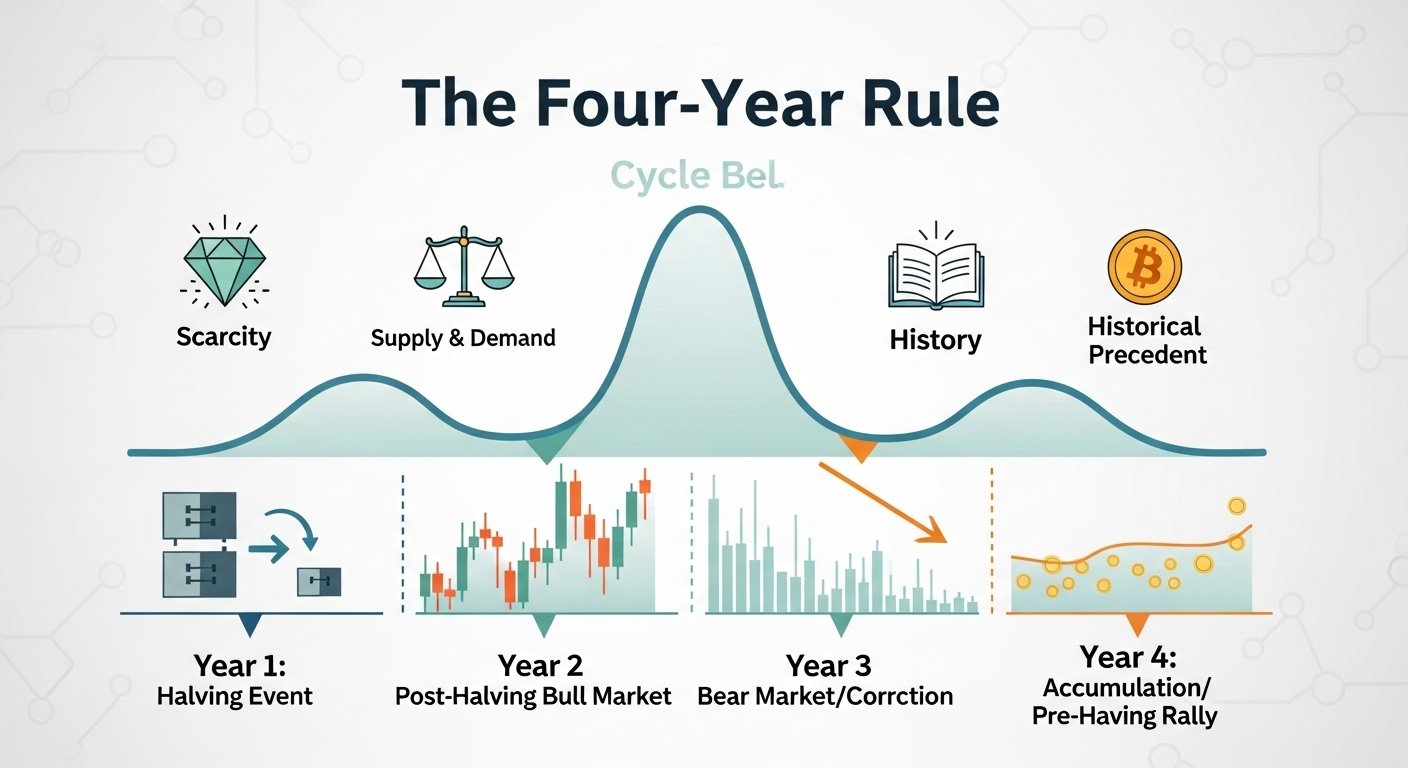 But cycles are not just about supply. They’re about behavior, leverage, macro conditions, and who holds the asset. Earlier Bitcoin cycles were dominated by retail flows and crypto-native leverage. As Bitcoin grew, more professional capital arrived—bringing deeper liquidity, more complex derivatives, and different hedging behavior. The Bitcoin four-year cycle remained visible, but the forces behind it began to diversify.
What CZ is claiming about 2026 and the “supercycle” idea
CZ’s message, as reported by multiple crypto and mainstream outlets, is that the traditional four-year pattern may not hold the same way going forward—and that 2026 could see a supercycle dynamic that breaks the familiar rhythm. In coverage of his remarks, the framing is clear: a Bitcoin supercycle 2026 could mean a longer, stronger expansion than past cycles, potentially changing how peaks and downturns look.
This doesn’t necessarily mean “up only.” A supercycle thesis usually implies that structural demand and market access improve enough that Bitcoin avoids the same magnitude of post-peak collapse—or that the cycle becomes less periodic and more trend-driven. Some reporting ties the thesis to policy and macro liquidity expectations, while emphasizing that the market’s old template may be less reliable.
It’s important to read this carefully. When someone says the Bitcoin four-year cycle may “break,” they might mean one of three things:
First, the timing could shift—peaks and troughs arriving earlier or later than the classic schedule. Second, the amplitude could change—less violent drawdowns or less explosive peaks. Third, the cycle could blur into a longer regime where adoption and capital flows keep the trend intact beyond what traders expect.
Why the Bitcoin four-year cycle might break this time
If the Bitcoin four-year cycle does break, it won’t be because the halving stopped happening. It will break because the halving becomes a smaller piece of a bigger puzzle. Several structural forces could weaken the cycle’s “clockwork” feel.
Institutional adoption changes the rhythm of demand
Bitcoin’s investor base has widened dramatically compared to earlier eras. As institutional adoption grows, capital allocation becomes more continuous and policy-driven. Institutions don’t typically “ape in” and “capitulate” like retail crowds. They rebalance. They hedge. They average in and out. And they may treat Bitcoin as a strategic exposure rather than a speculative lottery ticket.
If more demand behaves that way, the market may experience fewer blow-off tops and fewer catastrophic unwinds. That alone could reshape how the Bitcoin four-year cycle appears on a chart.
Spot ETFs and mainstream access can smooth volatility
One of the biggest market structure shifts in recent years has been the expansion of regulated, mainstream access vehicles. When capital can enter via familiar rails, the demand profile can change from episodic to persistent. ETF inflows and institutional allocation frameworks can create a steadier bid—especially if Bitcoin is increasingly treated as a portfolio diversifier.
That doesn’t eliminate drawdowns, but it can alter the cycle’s shape. A supercycle thesis often depends on this smoothing effect: fewer extreme leverage cascades, more steady long-term accumulation, and broader ownership.
Macro liquidity and policy may matter more than halving math
In prior cycles, Bitcoin was smaller relative to global capital markets. Now, macro conditions—rates, liquidity, risk appetite, and dollar strength—can influence Bitcoin’s trajectory more directly. If the next few years involve meaningful shifts in liquidity conditions, Bitcoin could trend in ways that don’t map neatly to the halving calendar.
On-chain maturation and long-term holder behavior
Bitcoin has a large cohort of long-term holders who historically sell into euphoric conditions and reaccumulate during deep bear markets. But as Bitcoin becomes more embedded in treasury strategies and long-duration portfolios, holder behavior may shift. If long-term holders grow as a share of circulating supply, and if fewer coins move during volatile periods, then the market’s reflexive “peak then crash” pattern could weaken.
This is one reason the Bitcoin four-year cycle could break: not because demand disappears, but because supply becomes stickier and less responsive to short-term sentiment.
The case for a monster Bitcoin supercycle 2026

A Bitcoin supercycle 2026 story needs more than optimism—it needs mechanisms. Here are the most plausible ones, explained in depth.
A demand regime that outpaces cyclical supply effects
In a classic Bitcoin four-year cycle, supply shock is a major driver. In a supercycle, demand drivers dominate. If adoption continues expanding across institutions, corporations, and even nation-state-aligned entities, then demand could remain elevated even after the “expected” post-halving window.
This is what would make 2026 special: the possibility that demand remains persistent enough that the market doesn’t revert to the familiar deep bear pattern on schedule.
A broader asset narrative: from speculation to monetary tech
Bitcoin’s narrative has gradually shifted from “internet magic money” to a more mainstream concept: an asset with scarcity, portability, and global settlement properties. Whether you agree with that thesis or not, the narrative matters because it shapes capital allocation decisions.
When the narrative becomes durable—less dependent on hype cycles—market cycles can stretch. That’s the emotional backbone of the Bitcoin supercycle 2026 argument: Bitcoin behaves less like a niche speculative trade and more like an increasingly accepted macro asset.
Infrastructure and regulation lowering friction
As regulation clarifies and infrastructure improves, the investor base expands. Lower friction means more consistent participation and fewer panic-driven liquidity gaps. If the market’s plumbing keeps improving—custody, prime brokerage, compliance pathways—then the “fragility” of earlier cycles can reduce.
Why the Bitcoin four-year cycle might not break after all

Skepticism is healthy here. Financial markets love neat narratives, and “the cycle is dead” is one of the oldest lines in investing. There are strong reasons the Bitcoin four-year cycle could remain relevant—even if it evolves.
Halvings still affect marginal supply
Even if Bitcoin is bigger and more institutional, the halving still changes the flow of new supply. Market impact often comes from marginal flows, not just total size. If demand doesn’t expand enough to offset shifts in leverage, liquidity, or sentiment, the cycle can still play out.
Leverage and derivatives can still amplify drawdowns
Bitcoin’s derivatives ecosystem is massive. Even if spot demand becomes steadier, leveraged positioning can still create sharp liquidations. Supercycles can still contain violent corrections; they just tend to recover faster. If leverage builds too aggressively, the market can still unwind in familiar ways.
Narrative risk is real
If too many participants assume the Bitcoin four-year cycle is broken, that belief itself can become a vulnerability. Crowded positioning and complacent risk management are classic ingredients for sharp corrections. In other words, the supercycle narrative can become the reason a supercycle fails.
What to watch in 2026 if you want to judge “cycle break” in real time
If you’re trying to evaluate whether the Bitcoin four-year cycle is actually breaking, the goal is not to predict a headline price. The goal is to watch whether market behavior matches the old template.
A key sign would be how Bitcoin behaves after major expansion phases. In prior cycles, late-stage euphoric moves tended to end with sharp, prolonged drawdowns. If 2026 shows repeated corrections that are deep but short-lived, with strong reaccumulation and resilient spot demand, that would support a supercycle interpretation.
Another sign would be whether the market’s dominant flows remain spot-driven rather than leverage-driven. Persistent, steady inflows, resilient liquidity during volatility, and continued accumulation by longer-duration holders would all imply a more mature regime.
Finally, watch macro. If Bitcoin trades more like a macro-sensitive asset—responding to liquidity shifts, risk-on/risk-off regimes, and policy expectations—then halving timing might matter less than the broader financial environment.
How investors can think about BTC positioning without betting everything on a narrative
Whether the Bitcoin four-year cycle breaks or not, the most practical approach is to treat narratives as scenarios, not certainties. A Bitcoin supercycle 2026 could happen, but so could a more traditional cycle with a familiar post-peak cooling period.
That’s why risk management matters more than prediction. If you’re bullish, structure your plan so you don’t require a perfect supercycle outcome. If you’re cautious, don’t dismiss the possibility that market structure has changed enough to punish overly bearish assumptions. The goal is to avoid being all-in on a single storyline.
In this context, CZ’s view is best treated as a high-profile signal that market participants should consider regime change seriously—not as a guarantee that the Bitcoin four-year cycle has already been rewritten.
Conclusion
The Bitcoin four-year cycle has been one of crypto’s most powerful organizing frameworks, largely because it aligned with Bitcoin’s halving cadence and repeated investor behavior. But markets evolve. Bitcoin’s investor base is changing, access is broadening, and macro conditions are playing a larger role. CZ’s reported belief that 2026 could bring a supercycle—and potentially break the old pattern—captures a real possibility: that Bitcoin is moving from a halving-dominated market into a structure-dominated market.
Still, the halving is not irrelevant, leverage remains a wildcard, and narratives can be self-defeating when they become too popular. The most realistic takeaway is this: the Bitcoin four-year cycle may not disappear overnight, but it could morph—shifting in timing, smoothing in amplitude, or stretching into longer trend phases. If 2026 becomes a monster Bitcoin supercycle 2026, it will likely be because demand becomes more continuous and structural than cyclical, supported by institutional adoption, improved access, and favorable liquidity conditions.
FAQs
Q: What is the Bitcoin four-year cycle in simple terms?
The Bitcoin four-year cycle is the idea that BTC tends to move in repeating phases—often linked to the halving—where prices rise strongly, peak, fall sharply, and then rebuild into the next expansion.
Q: What does “Bitcoin supercycle 2026” actually mean?
A Bitcoin supercycle 2026 scenario suggests BTC could experience a longer and potentially stronger uptrend than usual, with a less predictable post-peak crash, because demand and market structure overwhelm the old cycle template.
Q: Why do people think the Bitcoin four-year cycle could break?
Many believe the Bitcoin four-year cycle could break due to changing market structure: deeper institutional adoption, more regulated access like ETFs, and macro liquidity forces that may matter more than halving timing alone.
Q: Does CZ saying it’s a supercycle mean Bitcoin can’t crash anymore?
No. Even in a supercycle framework, Bitcoin can still correct sharply. The difference would be whether drawdowns are less prolonged or whether recovery is faster compared with the most severe bear markets of prior cycles.
Q: What are the biggest risks to the supercycle thesis?
Key risks include tightening global liquidity, excessive leverage, unfavorable regulation, or a demand slowdown. Another risk is narrative overcrowding—if everyone assumes the Bitcoin four-year cycle is dead, complacency can create conditions for a sharp reversal.
Also Read: Bitcoin price could hit $180,000 after key breakout
