

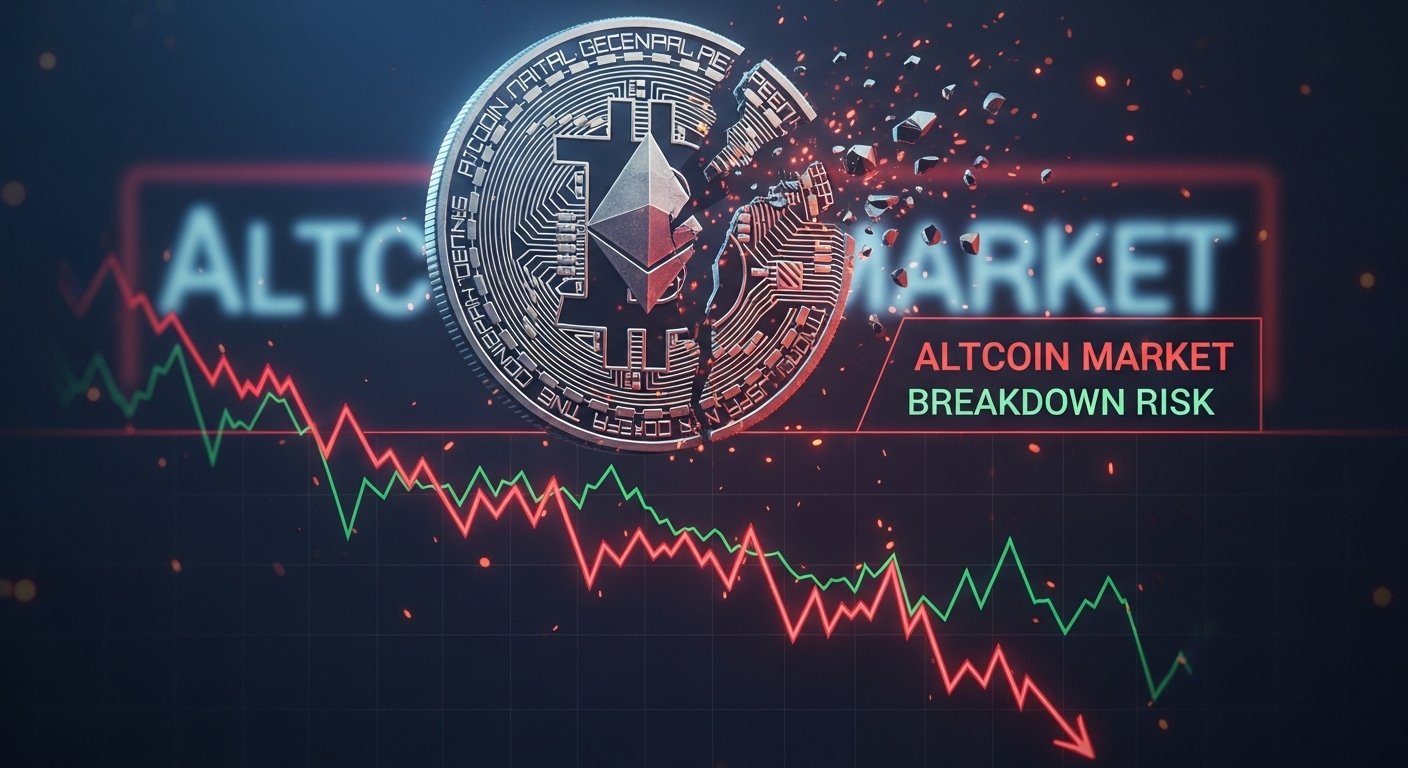
The altcoin market breakdown conversation is getting louder again, and not because traders enjoy drama. When the broader market starts leaning too heavily on a few large coins while the rest of the ecosystem weakens, it often signals that risk appetite is draining. That matters because the altcoin market tends to amplify whatever the wider crypto environment is doing—if liquidity flows in, altcoins can outperform fast, but if liquidity leaves, they can bleed harder and longer. Right now, many investors are watching whether the altcoin market breakdown becomes a full-blown shift in structure, with the total altcoin valuation potentially sliding toward the psychologically heavy $500B region.
This isn’t only about charts. The altcoin market is an ecosystem driven by narrative cycles, macro conditions, on-chain activity, and the psychology of crowd positioning. When funding cools, memecoin momentum stalls, and high-beta tokens fail to reclaim previous highs, the market starts to feel “thin.” Thin markets break levels quicker because there’s less demand layered below price to absorb selling. That’s why the altcoin market breakdown thesis has traction: traders see weakening breadth, rotating capital, and risk-off behavior that can accelerate downside if a key support zone gives way.
Altcoin market breakdown
At the same time, it’s important to stay objective. Crypto is famous for violent fakeouts. The altcoin market can look ready to collapse, only to reverse hard when liquidity returns or a major catalyst reignites risk appetite. So the real question isn’t whether a breakdown is “guaranteed.” It’s whether conditions are aligning for a meaningful probability shift—where a major drawdown becomes more likely than a clean recovery. And if that happens, how should traders and investors interpret the signals, manage risk, and position intelligently?
In this article, we’ll unpack the altcoin market breakdown risk from multiple angles: key technical levels, market breadth, liquidity and dominance metrics, the role of Bitcoin and Ethereum, and the narratives that typically drive altcoin cycles. We’ll also explore what a move toward $500B could mean in practical terms, and what signs would suggest the market is stabilizing instead of collapsing. The goal is clarity—not fear—so you can make decisions based on structure, not headlines.
Understanding the Altcoin Market Valuation and Why $500B Matters
The altcoin market is often measured by total market capitalization excluding Bitcoin, and sometimes excluding both Bitcoin and Ethereum depending on the framework. Either way, total value acts as a proxy for the health of speculative demand. When the total valuation expands, it usually means liquidity is flowing into riskier assets—Layer 2 tokens, DeFi coins, AI coins, gaming tokens, and newer narratives. When it contracts, it typically indicates capital is consolidating into majors or leaving crypto altogether.
The $500B level matters for two reasons. First, it’s a psychological round number that tends to attract attention from both discretionary traders and systematic funds. Second, it can represent a prior structural region where buyers previously defended the market during earlier drawdowns. In many cycles, the altcoin market tends to revisit major “decision zones” where the market previously transitioned from bearish to bullish. If the market breaks below one of those zones and fails to reclaim it, it can trigger another wave of selling, because traders interpret it as a structural reset rather than a normal pullback.
In simple terms, the altcoin market breakdown toward $500B would likely reflect a broader de-risking phase: fewer speculative bids, weaker narrative momentum, and reduced willingness to chase rallies. That doesn’t mean altcoins “die.” It means the market reprices risk, and the weakest or most overvalued assets tend to suffer the most.
Key Technical Signals Pointing to an Altcoin Market Breakdown
Technical analysis doesn’t predict the future, but it does reveal how participants are behaving around specific levels. A potential altcoin market breakdown often shows up in recurring patterns that traders should respect.
Loss of a Major Support Zone
When the altcoin market repeatedly tests a support area and bounces weaker each time, it signals that buyers are absorbing less supply. A clean break below that zone often leads to “air pockets” where price falls quickly because bids are sparse. If the market re-tests the broken support and fails to reclaim it, that level can flip into resistance, increasing the odds of continuation to the downside.
Lower Highs and Weak Market Structure
A common warning sign is a series of lower highs. This indicates rallies are being sold sooner, and sellers are gaining confidence. In the altcoin market, this can happen even while a few large coins hold up, masking weakness underneath. That’s why traders track breadth—because a market where fewer tokens participate is more fragile.
Volume Behavior and Failed Breakouts
If breakouts occur on low volume and then reverse sharply, that suggests buyers are not committed. Many altcoin market tops are formed when price makes a convincing move up, attracts late buyers, then collapses as liquidity dries up. A pattern of failed breakouts can support the altcoin market breakdown narrative, especially when paired with declining volatility expansion to the upside.
Market Breadth: The Silent Driver Behind Altcoin Weakness
Breadth is one of the most overlooked factors in crypto. The altcoin market can appear stable when a handful of high-cap tokens are holding levels, but internally, the majority of coins may already be trending down.
When fewer tokens are above key moving averages, or when most altcoins are underperforming Bitcoin, it indicates a risk-off environment. In this condition, capital often rotates toward “safer” crypto assets—Bitcoin, stablecoins, or sometimes Ethereum. That rotation can accelerate an altcoin market breakdown because altcoins rely on continuous speculative inflows to maintain elevated valuations.
A healthy altcoin market usually shows broad participation: DeFi, Layer 1s, gaming, infrastructure, and even microcaps moving together during expansion phases. A weak altcoin market shows fragmentation—short bursts in one niche, then quick collapses as traders take profits and flee back to safety.
Bitcoin Dominance and Liquidity Rotation: Why Altcoins Can Crack Fast
One of the most important macro indicators for the altcoin market is Bitcoin dominance. When Bitcoin dominance rises, it often means altcoins are bleeding relative to Bitcoin, even if the overall market looks calm. This is especially relevant during uncertain macro conditions or after speculative excess.
Liquidity rotation usually follows a familiar path. First, capital consolidates into Bitcoin. Then, if confidence returns, it spreads to Ethereum. Only after that does it typically flood into the broader altcoin market. If that sequence stalls—if the market stays stuck in Bitcoin-heavy positioning—altcoins can drift lower and eventually break key levels.
That’s why the altcoin market breakdown scenario becomes more plausible when Bitcoin dominance trends up alongside stablecoin inflows or reduced altcoin volume. It suggests traders prefer liquidity and safety, and that preference starves altcoins of the fuel needed to hold support.
Macro Pressure, Rates, and Risk Appetite in Crypto
Even though crypto is its own ecosystem, global liquidity conditions still matter. When risk assets are under pressure, speculative segments tend to suffer first. The altcoin market is effectively the highest-beta corner of crypto, which makes it sensitive to shifts in confidence.
If traders anticipate tighter financial conditions, reduced liquidity, or broader market volatility, they often reduce exposure to smaller tokens. That de-risking can feel sudden because altcoins have thinner order books, lower institutional support, and more reflexive crowd behavior. In those conditions, the altcoin market breakdown risk increases because selling pressure can cascade through support zones.
This doesn’t mean macro factors are the only driver. Crypto narratives can overpower macro for periods. But when both macro and internal crypto liquidity lean bearish at the same time, the downside can become sharper.
On-Chain and Sentiment Clues Traders Watch
Beyond price, the altcoin market often telegraphs stress through sentiment and on-chain behavior. When retail engagement drops, social metrics cool, and new capital slows, altcoins struggle to sustain rallies.
Funding rates and open interest can also provide clues. If leverage is elevated and price starts slipping, liquidations can accelerate moves lower. That dynamic frequently intensifies an altcoin market breakdown, because forced selling compounds organic selling. Conversely, if leverage resets and sentiment becomes extremely bearish, it can set the stage for a rebound—provided spot demand returns.
The key is alignment: price weakness plus deteriorating sentiment plus declining participation tends to be more bearish than price weakness alone.
What a Drop Toward $500B Could Look Like
A move toward $500B in total altcoin value would likely not be a clean straight line. It would probably include sharp relief rallies that trap late buyers, followed by renewed selling. Many investors underestimate how deceptive bear phases can be, because the altcoin market is famous for quick 20–40% bounces even during larger downtrends.
In this scenario, the strongest altcoins—typically those with real revenue, strong ecosystems, or durable user activity—might fall less and recover faster. The weakest altcoins—thin liquidity, weak product-market fit, overinflated token supply—could experience deep drawdowns and prolonged stagnation. In other words, an altcoin market breakdown often becomes selective punishment: quality survives, hype evaporates.
How to Manage Risk During an Altcoin Market Breakdown
If the altcoin market breakdown scenario is active, the goal is not to “guess the bottom,” but to stay solvent and flexible.
Reduce Position Size and Respect Volatility
Altcoins are volatile by nature. In breakdown conditions, that volatility becomes more asymmetric to the downside. Smaller position sizing can be the difference between calmly executing a plan and panic-selling at the worst time.
Favor Liquidity and Avoid Thin Microcaps
During fragile phases, liquidity matters. Highly liquid coins tend to have tighter spreads and less slippage, which reduces execution risk. Thin microcaps can become traps if bids disappear.
Use Levels, Not Emotions
If the altcoin market reclaims a major level and holds it with strong volume, the probability can shift toward stabilization. If it loses a level and fails to reclaim it, the risk remains elevated. Let structure guide decisions.
Keep a Watchlist for Relative Strength
Even during an altcoin market breakdown, a few tokens often show relative strength. Those coins can become leaders when the market turns. Tracking relative strength is more useful than chasing whatever is trending.
What Would Disprove the Breakdown Thesis
The altcoin market breakdown narrative is not permanent. Markets change when conditions change. A few signals often suggest the market is stabilizing instead of collapsing.
If altcoin total valuation reclaims a key support/resistance flip and holds it, that’s a strong start. If breadth improves—more tokens participating in rallies—that suggests healthier risk appetite. If Bitcoin dominance stalls or declines while altcoins outperform, that can indicate rotation back into the broader altcoin market. And if volume increases on up-moves rather than down-moves, it signals buyers are stepping back in with conviction.
In short, the breakdown thesis weakens when the market stops acting fragile and starts acting resilient.
Conclusion
The possibility of an altcoin market breakdown toward $500B is not just fear-driven speculation—it’s a scenario traders consider when market structure weakens, breadth deteriorates, and liquidity rotates away from high-beta assets. The altcoin market thrives on expanding risk appetite, broad participation, and narrative momentum. When those ingredients fade, the market becomes vulnerable to sharper repricing.
Still, crypto is dynamic. A breakdown is a probability, not a certainty. The smartest approach is to watch the key signals—support behavior, dominance trends, breadth, and liquidity—while managing exposure responsibly. Whether the market breaks down or stabilizes, disciplined risk management and structure-based decision-making will matter far more than any single prediction.
FAQs
Q: What does “altcoin market breakdown” mean?
An altcoin market breakdown generally refers to the total altcoin market losing a key support zone and shifting into a bearish structure where selling pressure increases and rallies fail more often.
Q: Why is $500B an important level for the altcoin market?
$500B is a major psychological and structural area traders watch because it can act as a historical decision zone where buyers previously defended the altcoin market, making it a key reference point.
Q: Does Bitcoin dominance rising always mean altcoins will crash?
Not always, but rising dominance often signals capital rotating into Bitcoin, which can weaken the altcoin market. If this happens alongside weak breadth and volume, the altcoin market breakdown risk increases.
Q: Which altcoins are usually hit hardest during a breakdown?
Tokens with low liquidity, weak fundamentals, heavy inflation, or purely hype-driven narratives tend to drop more during an altcoin market breakdown than higher-quality, more liquid projects.
Q: How can traders protect themselves if the altcoin market breaks down?
Risk control helps most: reduce position size, avoid illiquid microcaps, use clear invalidation levels, and watch relative strength. In a fragile altcoin market, survival and flexibility are the edge.
