


Bitcoin below $96000 has a way of turning ordinary policy headlines into market-moving moments. When Bitcoin slides below $96,000, it’s tempting to treat it as just another fluctuation in a famously volatile asset. But this move landed at a very specific intersection: a multi-day rally losing momentum at the same time a key U.S. crypto bill ran into trouble on Capitol Hill. That mix—price action colliding with political uncertainty—often changes how traders, long-term holders, and institutions position for what comes next.
In the latest bout of volatility, Bitcoin’s push higher faded quickly and the price fell back under the $96,000 level as the market reacted to a legislative snag in Washington. Reports tied the pullback to a roadblock for a major digital asset framework bill after Coinbase CEO Brian Armstrong publicly withdrew support, prompting a delay in Senate Banking Committee action.
This matters because markets don’t just trade earnings and charts anymore—they trade expectations about rules. If lawmakers are close to clarifying whether tokens fall under SEC or CFTC oversight, how exchanges must register, and what’s allowed in stablecoins and tokenized assets, capital markets pay attention. A stall can mean months of uncertainty, and uncertainty is kryptonite to risk appetite—especially for a high-beta asset like Bitcoin.
This article breaks down what happened, why Bitcoin below $96,000 became the market’s pressure point, what the stalled bill is actually about, and how traders and investors can think about next steps without getting trapped in hype or fear.
What happened as Bitcoin fell below $96,000
Bitcoin’s rally cooled abruptly and the price dropped back under $96,000 as traders digested news that a major U.S. digital asset bill hit a last-minute obstacle. The headline wasn’t simply “politics happened”—it was the kind of politics that directly affects market structure: who regulates crypto, what products are allowed, and how compliant businesses operate. According to reporting, the decline followed a multi-day rise that ran out of steam as the legislative setback became clear.
Why $96,000 became the line in the sand
Round numbers act like magnets in crypto markets. When Bitcoin slides below $96,000, it often triggers a psychological shift: dip-buyers hesitate, short-term traders tighten risk, and momentum algorithms stop chasing. Even if the “real” support is somewhere else on a chart, the headline level becomes a coordination point—especially when it’s paired with a catalyst like a stalled bill.
What made this specific move sharper is timing. The drop arrived just as the market was watching U.S. policy signals for validation that crypto’s regulatory framework is moving toward clearer rules. When that clarity got delayed, the market repriced the odds of near-term progress.
The “policy premium” in crypto prices
Crypto assets frequently carry what you can call a policy premium—an extra layer of optimism priced in when legislation seems likely to reduce uncertainty. When the odds of passage fall, that premium compresses. In this case, the Senate Banking Committee delayed action after Coinbase signaled it could not support the bill in its current form, disrupting the momentum narrative.
That doesn’t mean Bitcoin’s long-term trajectory depends on any single bill. It does mean short-term moves can be amplified when the market is leaning one way and a political headline forces a rethink.
The key crypto bill that stalled—and why it hit sentiment
The legislative snag centers on a major proposal described in coverage as the Digital Asset Market Clarity Act (often referred to as the Clarity Act)—a sweeping attempt to establish rules for digital assets and clarify which regulator oversees what. Reports said the Senate Banking Committee postponed a scheduled markup after opposition surfaced publicly, with Coinbase criticizing parts of the draft.
What the bill is trying to do (in plain English)
At its core, the Clarity Act aims to reduce ambiguity by defining when a crypto token should be treated like a security versus a commodity, and by outlining how spot market oversight would work. Reporting indicated the framework would place significant spot-market responsibility with the Commodity Futures Trading Commission (CFTC) while still addressing the securities perimeter.
For markets, this is huge. The U.S. remains one of the most important jurisdictions for liquidity, institutional participation, and corporate adoption. A clearer framework can encourage larger pools of capital to participate, while confusion tends to keep risk committees cautious.
Why Coinbase’s opposition changed the timeline
Coinbase isn’t just a company; it’s a bellwether for “regulated crypto” in the U.S. When its CEO said the firm couldn’t support the bill as written, it sent two signals at once: first, that the industry’s largest compliance-oriented players still see deal-breaking provisions; second, that lawmakers may not have the votes lined up if a major stakeholder is actively pushing back. Reuters reported the Senate Banking Committee delayed its discussion after Armstrong’s opposition, while other coverage described the vote as abruptly canceled.
Markets read that as: this won’t be resolved in a neat, immediate window. And when timelines stretch, traders reduce exposure.
The controversial pieces: stablecoin rewards and tokenized assets
Two hot spots stood out in reporting: restrictions around stablecoin rewards and concerns about tokenized equities and other on-chain representations of traditional assets. Coverage noted Coinbase’s concerns about provisions that could restrict stablecoin rewards and potentially ban or limit tokenized stocks.
The stablecoin angle matters because yield-like incentives have become a mainstream feature of crypto platforms, and policymakers are balancing innovation against bank-like risks. The tokenized-equities angle matters because it touches capital markets infrastructure, broker-dealer rules, and the boundary between securities law and crypto-native settlement.
Why Congress can move Bitcoin prices in a single day
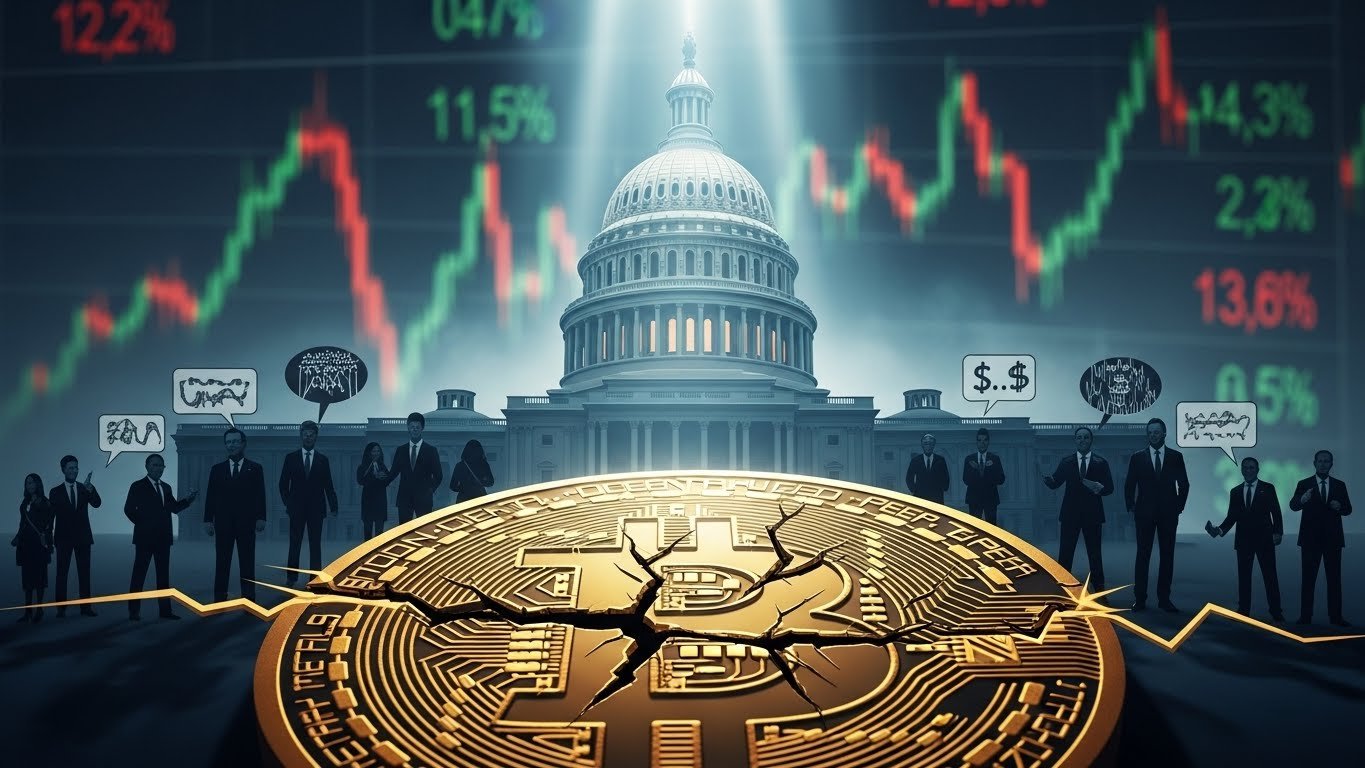
If you’ve been in crypto long enough, you’ve seen it: one hearing, one leaked draft, one sudden delay—then Bitcoin jolts. That’s because regulation isn’t just “background.” It shapes market plumbing: listings, custody, banking access, and whether large institutions can participate without reputational risk.
Regulatory clarity versus regulatory crackdown
A stalled bill doesn’t automatically mean a crackdown is coming. But it does extend the period where enforcement, litigation risk, and agency turf battles can dominate. In those environments, investors often price in higher compliance costs and the risk of abrupt rule interpretations. The Clarity Act was positioned as a path toward predictable rules; delaying it revives the “wait and see” posture.
Institutional capital is hypersensitive to rulebooks
Large allocators don’t just ask, “Is Bitcoin going up?” They ask, “Is the framework stable enough that we can hold this through a policy cycle?” When headline risk rises, inflows can pause, and a pause is enough to turn a grind-up rally into a pullback—especially at levels like Bitcoin below $96,000, where positioning can be crowded.
The feedback loop between headlines and liquidity
Crypto markets can be thinner than they look, particularly during sudden risk-off moments. If traders simultaneously reduce leverage, take profit, and hedge, price can slide quickly. That’s how “Bitcoin slides below $96,000” becomes a self-reinforcing headline: the story drives the move, and the move drives the story.
Market structure matters—because it determines “who can play”
When people hear “market structure bill,” it can sound abstract. But market structure is basically the rulebook for exchanges, brokers, dealers, and products. It determines which venues can list what, what disclosures are required, and what consumer protections apply.
SEC vs CFTC: the fight the market wants resolved
One of the most important parts of any U.S. crypto framework is the boundary between SEC and CFTC jurisdiction. Reuters described the draft bill as defining when tokens are securities or commodities and giving the CFTC spot market oversight.
Bitcoin tends to be seen as more commodity-like in market narratives, but the broader ecosystem—including major tokens and platforms—cares intensely about where that line is drawn. When the line is unclear, the market often prices a “regulatory discount.”
Why spot market oversight is a big deal
In traditional finance, the spot market is foundational. If spot crypto oversight is standardized, it can unlock more robust participation by institutions, market makers, and custodians. A stalled process delays that potential unlock. Even if Bitcoin’s fundamentals are unchanged, the pathway for capital flows gets foggier.
Technical and psychological drivers behind the drop
Legislation may have been the spark, but price action is rarely driven by just one factor. When Bitcoin slides below $96,000, traders also look at positioning, leverage, and key levels that have acted as support or resistance.
Momentum trades unwind fast
During multi-day rallies, momentum strategies pile in. When a surprise headline hits—like a committee delay—momentum can reverse. That reversal isn’t a moral judgment on Bitcoin; it’s just the mechanics of short-term trading.
The role of derivatives and liquidation cascades
Even modest spot selling can cause bigger moves if derivatives positioning is stretched. As price dips, some leveraged longs may be forced to close, adding sell pressure. This can make Bitcoin’s drop below a headline level feel more dramatic than the underlying news alone would justify.
Why “support” is often a story we tell afterward
Support levels are real in the sense that many traders watch them—but they’re also narrative anchors. The market will later explain the move as “losing support,” when the real driver may have been the sudden repricing of policy odds.
How the stalled crypto bill could evolve from here
A delay doesn’t mean defeat. It means negotiations are still in motion, and outcomes can shift quickly. Reuters quoted Senate Banking Committee Chairman Tim Scott emphasizing that bipartisan discussions were ongoing.
Three paths: fix it, split it, or shelve it
One path is revision: lawmakers adjust the most disputed sections—especially around stablecoin rewards, tokenized equities, and any perceived constraints on DeFi mechanics—until key stakeholders come back on board. Another path is segmentation: Congress advances narrower pieces first, leaving the hardest issues for later. A third path is delay into a more distant political window, which markets would likely interpret as prolonged uncertainty.
Why “bad legislation is worse than none” is market-relevant
Armstrong’s view, as reported, was essentially that poorly structured rules could be worse than no rules.
For markets, that idea cuts both ways. It suggests industry leaders prefer waiting for a better framework rather than accepting restrictions they believe would distort competition. But it also signals that passage isn’t guaranteed without substantial edits, which can keep the policy premium muted.
What this means for investors and traders (without hype)
Let’s keep it grounded. A move where Bitcoin slides below $96,000 is meaningful, but it isn’t automatically a trend reversal or a doomsday signal. It’s a reminder that Bitcoin trades like a global macro asset plus a regulatory-risk asset at the same time.
For long-term holders: focus on time horizon, not headlines
If your thesis is multi-year adoption, decentralization, and scarcity, a legislative delay is noise—though it can affect the pace of institutional integration in the U.S. The biggest mistake long-term holders make is letting short-term political headlines force emotional decisions.
For short-term traders: volatility is the product
If you’re trading weeks or days, then yes—Washington headlines matter. Risk management matters even more. Treat “Bitcoin below $96,000” as a regime where sudden reversals can happen and size positions accordingly.
For everyone: separate “price action” from “policy reality”
Policy negotiations are messy by design. Bills get rewritten, votes get delayed, and stakeholders posture. The market will swing on each update. The healthiest approach is to track what actually changes in the bill and whether committee action resumes, rather than trading every rumor.
Conclusion
When Bitcoin slides below $96,000 alongside a stalled U.S. crypto market structure bill, the market is reacting to uncertainty more than fundamentals. The legislative pause—sparked by high-profile industry opposition and unresolved disputes over stablecoin rewards, tokenized equities, and regulatory jurisdiction—reduced confidence in near-term clarity and pressured sentiment.
Whether Bitcoin rebounds quickly or chops lower, the bigger takeaway is that regulation has become a first-order variable for crypto pricing—especially in the United States. As Congress debates the rulebook, Bitcoin will keep trading not just on charts, but on the probability that the next framework expands participation rather than constrains it.
FAQs
Q: Why did Bitcoin drop below $96,000 today?
Bitcoin fell back under $96,000 as a major U.S. digital asset bill hit a roadblock, with the Senate Banking Committee delaying action after Coinbase publicly withdrew support for the draft as written.
Q: What is the “Clarity Act” and why does it matter?
Reporting describes it as a broad framework bill intended to clarify when tokens are securities or commodities and to set clearer oversight—potentially giving the CFTC a major role in spot crypto markets. That kind of clarity can influence institutional participation and market confidence.
Q: What parts of the bill are most controversial?
Coverage highlights disputes around limits on stablecoin rewards and concerns about restrictions affecting tokenized equities and other on-chain financial products, with Coinbase citing these issues in its opposition.
Q: Does a stalled bill mean crypto regulation is dead in the U.S.?
Not necessarily. Committee delays often mean negotiations are ongoing. Reuters reported bipartisan discussions were still happening, implying the text could change and return to consideration.
Q: Should investors expect more volatility around U.S. policy headlines?
Yes. Crypto markets frequently price in a “policy premium” when progress toward clear rules seems likely and remove it when timelines slip. That’s why developments in Congress can amplify moves like Bitcoin dropping below $96,000.
Also More Cryptocurrencies Price Prediction European Wrap Jan 12
