


Ethereum starts planning for a post-quantum future at a time when the crypto industry is shifting from pure speculation to long-term resilience. For years, the biggest threats to blockchain networks were considered familiar: exchange hacks, phishing, smart contract bugs, and regulatory uncertainty. Now, a new category of risk is joining the conversation—one that sounds futuristic, but is being treated as a practical engineering problem: quantum computing.
The reason Ethereum starts planning for a post-quantum future isn’t because quantum computers are about to crack cryptography tomorrow. It’s because Ethereum is a global settlement layer for value, identity, and programmable finance. If the network is going to remain trustworthy for decades, it needs to anticipate threats that could emerge over that same timeframe. Quantum computing challenges some of the cryptographic assumptions that protect private keys and validate signatures today. Even if large-scale quantum attacks are years away, the decisions Ethereum makes now—about standards, migration paths, wallet design, and protocol upgrades—will determine how smoothly the ecosystem can adapt later.
This is also about confidence. Ethereum is not just software; it is an economic system built on the belief that ownership cannot be forged and transactions cannot be rewritten. A successful quantum attack against widely used signature schemes could undermine that belief by enabling adversaries to steal assets or impersonate accounts. That’s why Ethereum starts planning for a post-quantum future in public, through research, proposals, and discussions among core developers and cryptographers. It’s an acknowledgement that security is not a single upgrade, but a long-term strategy.
In this article, you’ll learn what “post-quantum” really means for Ethereum, why the threat is different from typical hacks, which cryptographic components are most exposed, and how Ethereum can transition to quantum-resistant cryptography without breaking the network’s usability. You’ll also see how this affects wallets, institutions, staking, smart contracts, and everyday users—and what steps you can take to prepare.
What “Post-Quantum” Means for Ethereum
When people hear “post-quantum,” they often imagine a sudden moment where quantum computers instantly break blockchains. In reality, Ethereum starts planning for a post-quantum future because the risk is gradual and layered. “Post-quantum” refers to cryptographic systems designed to remain secure even if an attacker has access to a sufficiently powerful quantum computer. These systems are usually called post-quantum cryptography (PQC) and are intended to replace or supplement the classical cryptography used today.
Ethereum relies heavily on public-key cryptography, especially digital signatures. A user’s private key is used to create a signature; the network verifies that signature using the corresponding public key. This is foundational: it’s how ownership is proven, how transactions are authorized, and how accounts are controlled. Ethereum starts planning for a post-quantum future because certain classical signature schemes could be vulnerable to quantum algorithms like Shor’s algorithm, which can dramatically reduce the difficulty of problems that are considered hard for classical computers.
It’s also important to understand a subtlety: the “post-quantum future” doesn’t just mean quantum computers exist. It means adversaries can practically use them at scale and at cost levels that make attacks plausible. Ethereum’s planning is about building flexibility: if the threat materializes faster than expected, the network should already have a migration route. If it materializes slowly, the ecosystem still benefits from better cryptographic hygiene and safer standards.
Another dimension is data longevity. Even today, attackers can adopt a “harvest now, decrypt later” approach—collecting encrypted data or public information now, with the intent to break it when quantum capabilities improve. Ethereum starts planning for a post-quantum future partly because cryptographic transitions are hard, and you don’t want to begin only after the pressure becomes urgent.
Why Quantum Computing Threatens Today’s Blockchain Security
Ethereum starts planning for a post-quantum future because quantum computing changes the economics of cryptographic attacks. Classical security depends on the idea that certain mathematical problems are infeasible to solve with traditional computation at realistic costs. Quantum computing introduces new algorithms that can make those problems easier, potentially turning “impossible” into “expensive but doable,” and eventually into “cheap enough for criminals.”
For blockchains, the most talked-about risk is signature forgery. If an attacker can derive your private key from your public key, they could sign transactions as if they were you. That’s different from most common crypto theft scenarios, where attackers typically trick users into signing malicious transactions or compromise devices. A quantum-capable attacker could bypass user behavior entirely and focus on cryptographic extraction.
However, Ethereum starts planning for a post-quantum future not because every cryptographic component is equally vulnerable. Some primitives are more exposed than others. Hash functions, for example, are generally considered more resistant to quantum attacks than public-key schemes, though they may require larger parameters for equivalent security. The more immediate concern is the public-key signature layer used for accounts, validators, and transaction authorization.
There’s also a “coordination risk” factor. Even if post-quantum solutions exist, upgrading a global network with millions of users, countless wallets, exchanges, and smart contracts is not like patching an app. Ethereum starts planning for a post-quantum future because the hardest part may not be the math—it may be migration, backwards compatibility, and ensuring the upgrade doesn’t create new attack surfaces.
The Cryptography Ethereum Uses Today and What’s Exposed
To understand why Ethereum starts planning for a post-quantum future, it helps to look at what Ethereum uses today. On Ethereum, most externally owned accounts (EOAs) and transaction signatures are based on elliptic curve cryptography, typically associated with ECDSA over secp256k1. The security assumption here is that deriving a private key from a public key is computationally infeasible for classical machines.
Quantum computing threatens that assumption. Shor’s algorithm can, in principle, solve the underlying discrete logarithm problem far more efficiently than classical methods. That means the signature scheme that secures many Ethereum accounts could become vulnerable once quantum computers reach sufficient scale and stability.
Ethereum starts planning for a post-quantum future because the exposure is not uniform across all users. In Ethereum-style systems, your public key is not always directly visible until you use it in a transaction. Depending on account type and how keys are revealed, the attack window can differ. Yet in practice, many public keys become visible through normal usage patterns, and the ecosystem cannot rely on obscurity as a security strategy.
Smart contract wallets complicate the picture in a useful way. Many modern accounts are moving toward contract-based accounts (often associated with account abstraction approaches). Ethereum starts planning for a post-quantum future partly because contract accounts can be designed with flexible authentication rules, allowing users to swap signature schemes or adopt quantum-resistant signatures without changing the base layer as aggressively. This flexibility could make migration smoother.
But validators also matter. Ethereum’s proof-of-stake security model depends on validators signing messages. If validator keys were compromised via quantum attacks, it could affect consensus integrity. That doesn’t necessarily mean the chain collapses, but it raises serious operational and economic risks. Ethereum starts planning for a post-quantum future to ensure that staking infrastructure can evolve along with wallet infrastructure, rather than becoming a bottleneck.
Ethereum’s Post-Quantum Roadmap: What Planning Could Look Like
Ethereum starts planning for a post-quantum future through a mix of research, experimentation, and standards alignment rather than one sudden protocol flip. A realistic roadmap tends to include multiple phases: identifying candidate algorithms, implementing optional support, encouraging wallet-level migration, and eventually enforcing stronger defaults.
Research and Standardization: Choosing the Right Tools
Post-quantum cryptography is not one algorithm. There are families—lattice-based, hash-based, code-based, and more. Each has tradeoffs in key size, signature size, verification speed, and implementation complexity. Ethereum starts planning for a post-quantum future because these tradeoffs matter at blockchain scale, where every byte of data and every computation can affect network costs.
Ethereum’s planning also benefits from broader cryptographic standardization work. The ecosystem needs algorithms that are widely reviewed, resistant to known attacks, and supported by security libraries. Ethereum starts planning for a post-quantum future by aligning with credible, heavily-audited options rather than inventing bespoke cryptography.
Protocol and EVM Considerations
A major constraint is execution cost. If post-quantum signatures are large or expensive to verify, verifying them on-chain could be costly. Ethereum starts planning for a post-quantum future by exploring how verification can be made efficient—potentially through precompiles, optimized verification primitives, or new transaction types that handle post-quantum signature verification more gracefully.
There’s also the question of interoperability. Ethereum is not isolated; it interacts with bridges, rollups, and off-chain systems. A post-quantum transition must avoid fragmenting standards in a way that breaks compatibility. Ethereum starts planning for a post-quantum future with the understanding that the base layer, layer-2s, and wallet providers must move together.
Account Abstraction and Smart Contract Wallets as a Bridge to PQC
One of the most practical reasons Ethereum starts planning for a post-quantum future is that Ethereum already has a pathway to more adaptable accounts. Contract wallets can define custom verification logic. That means a user can potentially adopt quantum-resistant cryptography inside a contract account without forcing all EOAs to switch instantly.
This is significant because it turns the post-quantum shift into an opt-in evolution rather than an overnight migration. If you can create an account that uses a post-quantum signature scheme, you can begin protecting assets early. Over time, as tooling improves, more users can migrate. Ethereum starts planning for a post-quantum future because this staged approach reduces the risk of network-wide disruption.
However, there are limits. If verification is too costly, a contract wallet could become expensive to use. Ethereum starts planning for a post-quantum future by considering protocol-level optimizations to keep contract-based authentication efficient. This is where precompiles, gas schedule changes, or native support may become important.
Account abstraction also supports multi-factor style security, social recovery, and key rotation. These features are already good for everyday security, and they become even more valuable in a post-quantum context where users may need to rotate away from vulnerable keys. Ethereum starts planning for a post-quantum future by leaning into designs that make rotation normal and user-friendly.
Migration Challenges: From Classical Keys to Quantum-Resistant Keys
Even if post-quantum algorithms are ready, migration is the hard part. Ethereum starts planning for a post-quantum future because the ecosystem must move billions of dollars and millions of accounts safely. A migration strategy has to account for users who are inactive, lost keys, old wallets, and long-term cold storage.
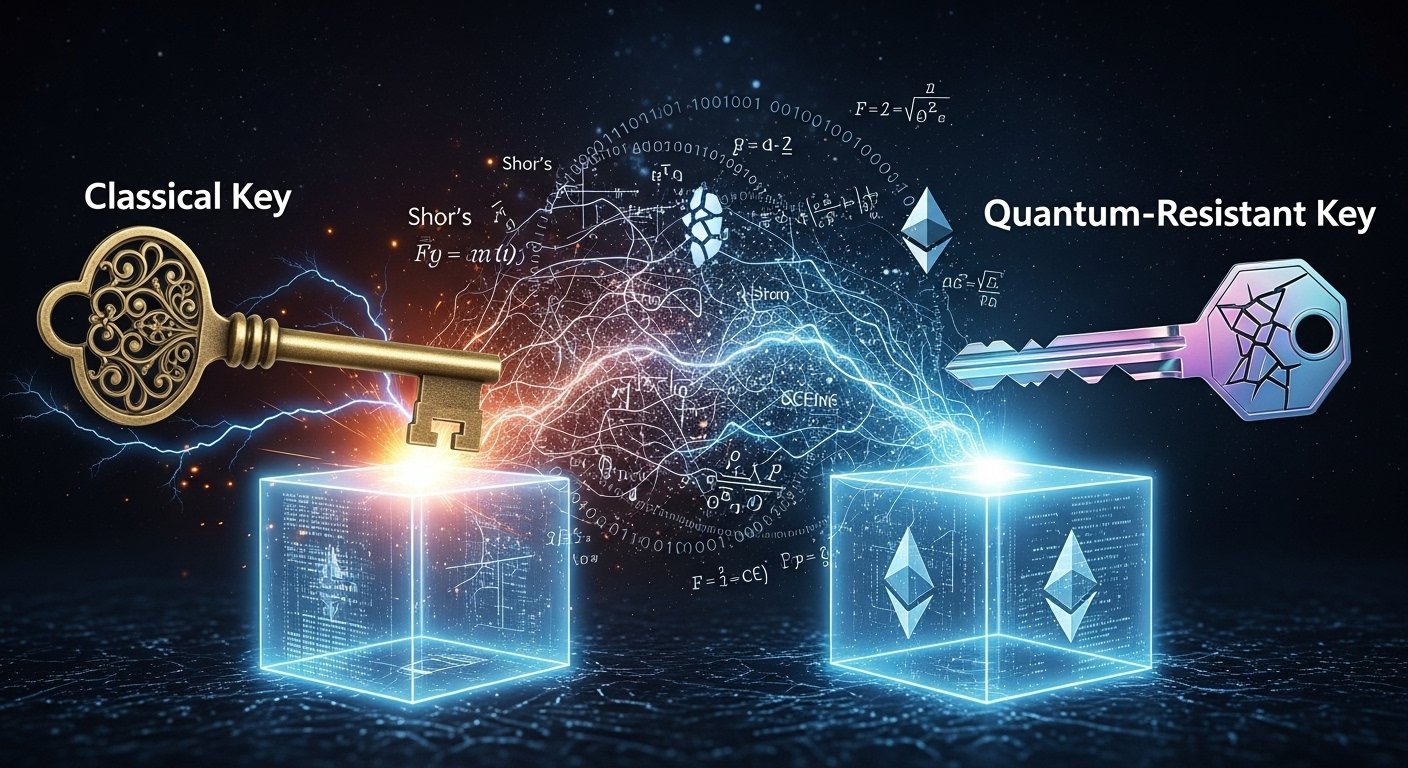
One key challenge is key exposure. If a user’s public key is visible on-chain and quantum capabilities arrive suddenly, the window to move funds could be short. Ethereum starts planning for a post-quantum future to prevent a chaotic scenario where everyone rushes to transfer funds at the same time, causing congestion and high fees.
Another challenge is address formats and compatibility. Ethereum addresses are derived from public keys, but simply switching to a new signature scheme may imply different key formats or different address derivation methods. Ethereum starts planning for a post-quantum future by exploring approaches that preserve usability—ideally allowing users to keep familiar address structures or at least migrate with minimal friction.
There is also a social and educational dimension. Most users do not understand signature schemes, and they shouldn’t have to. Ethereum starts planning for a post-quantum future with the recognition that wallets and interfaces must hide complexity while still providing meaningful safety guarantees.
What This Means for Wallets, Exchanges, and Everyday Users
Ethereum starts planning for a post-quantum future in a way that will inevitably touch the tools people use most. Wallets are likely to be the front line of post-quantum adoption because they manage keys, sign messages, and present upgrade prompts. In a well-designed transition, wallet software will offer users a guided path: create or upgrade to a contract account, enable post-quantum signatures, and migrate funds when convenient.
Exchanges and custodians face their own challenges. They manage large pools of assets and often rely on hardware security modules (HSMs), custody policies, and multi-signature arrangements. Ethereum starts planning for a post-quantum future in part because institutional adoption depends on clear standards, audited implementations, and predictable timelines. Institutions will not move on vague promises; they need tested cryptography and stable protocol support.
For everyday users, the biggest practical change may be a shift in what “safe” looks like. Today, best practices include hardware wallets, avoiding phishing, and careful approvals. In a post-quantum context, best practices may expand to include upgrading account types, rotating keys periodically, and using wallet features that support cryptographic agility. Ethereum starts planning for a post-quantum future so that these practices can become normal long before they become urgent.
Post-Quantum Ethereum and Layer-2s: Rollups, Bridges, and Scaling
Ethereum’s ecosystem includes many layer-2 scaling solutions. Ethereum starts planning for a post-quantum future with the understanding that rollups and bridges also rely on cryptography for security proofs, fraud proofs, or validity proofs. While the quantum threat is most obvious for signatures, any cryptographic assumption at scale deserves scrutiny.
If layer-2 systems use signature schemes or key management methods that are quantum-vulnerable, those systems could become weak links even if Ethereum mainnet upgrades. Ethereum starts planning for a post-quantum future by encouraging ecosystem-level coordination, so that upgrades don’t happen in isolation.
Bridges are particularly sensitive because they often hold large amounts of value and have historically been targeted. A post-quantum future requires not only safer cryptography but also safer architecture. Ethereum starts planning for a post-quantum future as part of a broader trend toward minimizing trusted components and improving verification assumptions across the stack.
The Tradeoffs: Performance, Cost, and Usability in a Post-Quantum World
Ethereum starts planning for a post-quantum future because “more secure” is not the only requirement. Post-quantum signatures can be larger than classical signatures, and verifying them can be computationally heavier. On a blockchain, that affects transaction fees, block propagation, and storage bloat.
A good post-quantum design must balance several goals. It should be secure against known quantum algorithms. It should be efficient enough for widespread use. It should be implementable safely, avoiding pitfalls that lead to side-channel attacks or bugs. Ethereum starts planning for a post-quantum future by treating this as an engineering optimization problem, not just a cryptography selection.
Usability matters too. If post-quantum wallets are awkward, slow, or incompatible with existing dApps, adoption will stall. Ethereum starts planning for a post-quantum future by focusing on pathways that preserve the feel of Ethereum—fast signing, smooth UX, familiar account experiences—while quietly upgrading the underlying security model.
How Developers Can Prepare: Smart Contracts and Authentication Design
Developers building on Ethereum also have a stake in the post-quantum transition. Ethereum starts planning for a post-quantum future in a way that may change how authentication and authorization are implemented in dApps. If more users adopt contract wallets with flexible validation, dApps that assume EOAs may need to evolve.
Smart contract design can be made more post-quantum-friendly by minimizing reliance on fragile off-chain signatures, avoiding hardcoded assumptions about signature types, and embracing account standards that support multiple verification methods. Ethereum starts planning for a post-quantum future, but developers help shape how smooth the transition is by designing dApps that work with evolving account models.
There’s also the matter of long-term data verification. Some applications rely on signed messages that must remain verifiable years later. Ethereum starts planning for a post-quantum future suggests that developers should consider how proofs and signatures are stored and validated over time, especially for identity, credentials, or legal-grade attestations.
Conclusion
Ethereum starts planning for a post-quantum future because the network is designed to last. Quantum computing may not be an immediate threat, but cryptographic transitions cannot be rushed when the stakes are global and the ecosystem is massive. By treating quantum risk as a real engineering constraint today, Ethereum positions itself to evolve without panic tomorrow.
The most likely path forward blends careful research with pragmatic migration strategies: adopting post-quantum cryptography, enabling quantum-resistant signatures through flexible account models, optimizing verification at the protocol level, and coordinating upgrades across wallets, validators, and layer-2 systems. The end goal isn’t to “fear quantum.” It’s to build Ethereum into a cryptographically agile platform that can survive whatever computing breakthroughs come next.
In a world where technology accelerates unpredictably, Ethereum starts planning for a post-quantum future is less a headline and more a philosophy: secure systems are the ones that prepare early, upgrade gracefully, and keep users safe without forcing them to become cryptographers.
FAQs
Q: What does “post-quantum” mean for Ethereum users?
It means Ethereum starts planning for a post-quantum future by preparing ways for users to secure accounts with quantum-resistant cryptography, so signatures can’t be forged even if quantum computers advance.
Q: Can quantum computers steal Ethereum directly today?
Not with today’s practical capabilities. Ethereum starts planning for a post-quantum future because the risk grows over time, and migrations take years to roll out safely across wallets and infrastructure.
Q: Will Ethereum addresses change in a post-quantum upgrade?
Possibly, depending on how new keys and signatures are integrated. Ethereum starts planning for a post-quantum future with an emphasis on minimizing disruption, which could include migration tools or contract-based accounts that preserve familiar user experiences.
Q: Are smart contract wallets better for post-quantum security?
They can be. Ethereum starts planning for a post-quantum future partly because contract wallets can implement flexible authentication, making it easier to adopt post-quantum signatures and rotate keys.
Q: What should I do now to prepare for a post-quantum future?
Stay updated on wallet security features, consider using modern account designs that support key rotation, and avoid leaving large funds in inactive addresses for long periods. Ethereum starts planning for a post-quantum future, and users benefit most when they adopt tools that can upgrade smoothly.
Also Read: How Fed Selling Dollars for Yen Affects Bitcoin Price
