

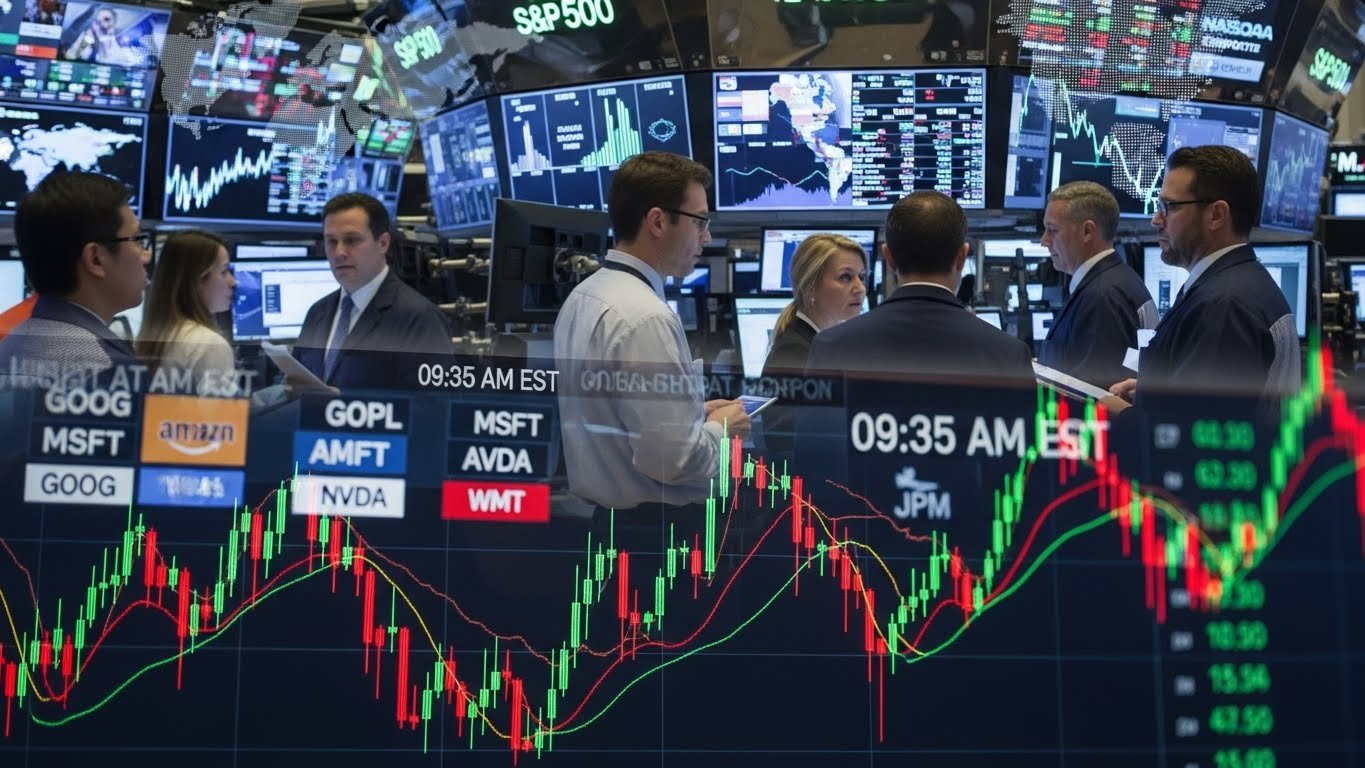
The stock market today is starting December on a shaky note. After a powerful late-November rally that helped the Dow Jones Industrial Average, S&P 500, and Nasdaq Composite avoid a monthly loss, U.S. stocks have reversed course, opening the new month in the red. The Dow is down roughly one percent, or about 350–430 points, while the S&P 500 has slipped around half a percent and the Nasdaq is off about 0.4%.
At the same time, bitcoin has stumbled badly. The bitcoin price has fallen around 6–7% in just a day, briefly plunging below 84,000 dollars before stabilizing near 87,000 dollars, extending a rough stretch in which the world’s largest cryptocurrency dropped about 17% in November and roughly 30% from its October peak above 120,000 dollars. This violent crypto crash has erased tens of billions of dollars in market value and spooked investors across risk assets.
When you look at the stock market today, you are seeing the collision of several forces at once: profit-taking after a strong run, renewed pressure from bond yields, and a sharp repricing in cryptocurrencies. For everyday investors, it can feel like whiplash: one week of strong gains followed by sudden selling across stocks and digital assets. Yet this kind of choppy start to December is not unusual, and understanding what is happening beneath the surface can turn noise into insight.
In this in-depth guide, we’ll break down how the major indexes are performing, why bitcoin is tumbling, how crypto volatility feeds back into equities, and what it all means for your strategy in the stock market today and over the rest of December.
Wall Street stumbles after a strong November rebound
The first trading days of December are challenging the optimism that powered markets through the end of November.
How the major indexes performed
On Monday’s session that kicked off December, the Dow Jones Industrial Average dropped close to 0.9%, translating to a fall of roughly 350–430 points by the closing bell. The S&P 500 slipped around 0.5%, while the tech-heavy Nasdaq Composite declined about 0.4%, signaling broad but not panicked selling across U.S. equities.
These moves came just days after a robust Thanksgiving-week rally pushed both the Dow and the S&P 500 back into positive territory for November. In other words, the stock market today is giving back a portion of those gains rather than starting a brand-new downtrend from scratch.
Investors watching stock market index performance can see the story clearly: indexes are pulling back from recent highs, with cyclical sectors and growth names under renewed pressure, while defensive pockets of the market are holding up comparatively better.
Thanksgiving rally meets December reality
The late-November surge was fueled by hopes of interest-rate cuts, solid consumer spending data, and strong showings from large-cap tech and AI-linked stocks. But markets don’t move in straight lines. After multiple days of gains and improving sentiment, the stock market today is dealing with a natural round of consolidation.
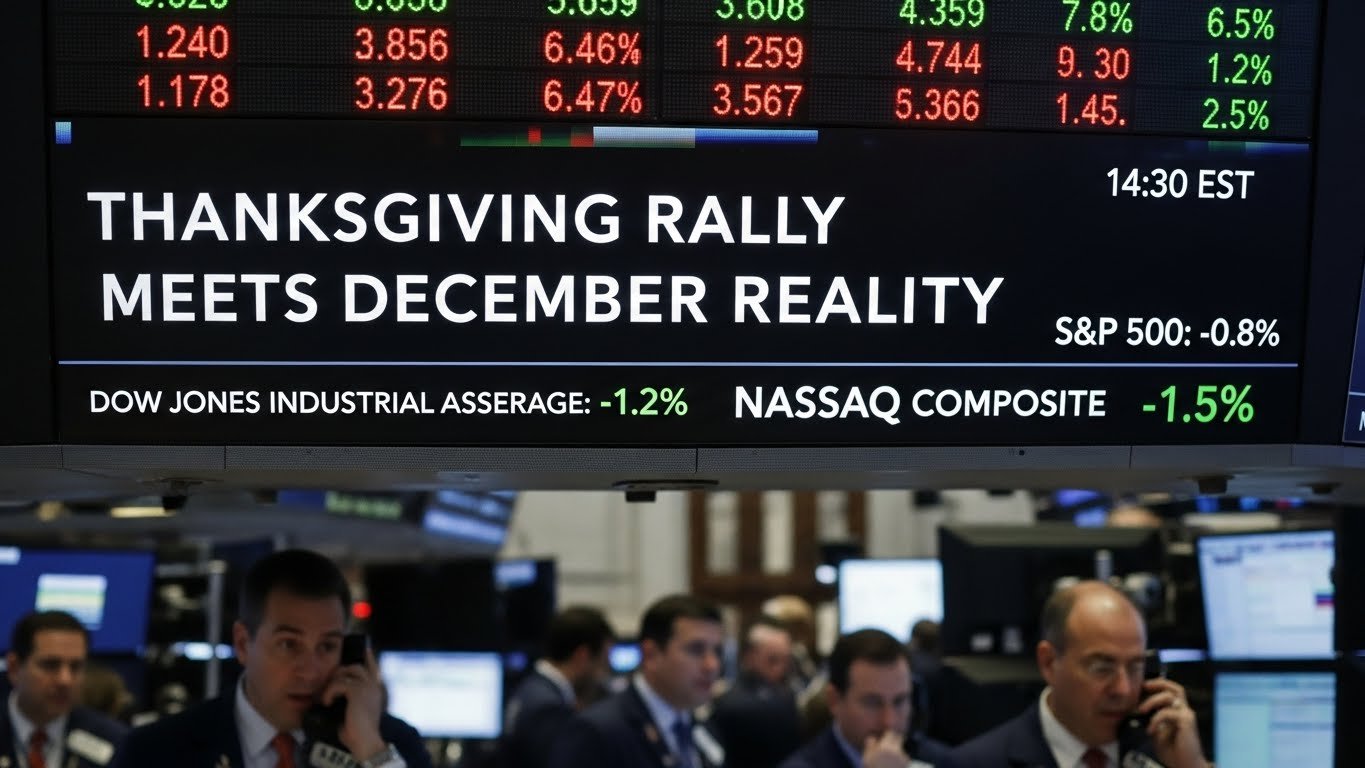
This kind of reversal as a new month begins can reflect portfolio rebalancing. Fund managers who benefited from the November rebound may be locking in profits, trimming exposure to high-beta growth shares, and preparing for potential volatility tied to economic data releases and central bank commentary later in December.
Why stocks are sliding to start December
The pressure on the Dow, S&P 500, and Nasdaq is not happening in isolation. Several macro forces are amplifying the pullback and making investors more cautious.
Rising bond yields and global rate jitters
Global bond markets are playing an important role in the stock market today. A sharp selloff in bonds, partly driven by expectations that Japan may tighten monetary policy, has pushed yields higher around the world. Rising yields make future corporate earnings less attractive in discounted cash-flow models and can weigh particularly heavily on growth and tech stocks that depend on long-dated profit expectations.
In the U.S., Treasury yields have climbed, reflecting both global rate moves and shifting expectations about the Federal Reserve’s path in 2026. Higher yields often create competition for investor capital: when “risk-free” bonds pay more, some investors choose to rotate out of equities, which adds selling pressure on the stock market today.
Profit-taking after a powerful rally
The recent drop also reflects plain old profit-taking. After several sessions of gains, the S&P 500 and Dow entered December close to short-term resistance levels Traders who bought the dip earlier in November are now booking profits, especially in sectors that surged the most, such as technology, AI-linked chipmakers, and travel and leisure names that benefited from strong holiday demand.
This kind of behavior is common at the start of a new month, when funds rebalance and re-align portfolios. Rather than signaling a full-blown trend reversal, it may simply mark a pause in an uptrend—although the stock market today is clearly more fragile than it was just a week ago.
Bitcoin tumbles and shakes risk sentiment
While stocks are under pressure, bitcoin’s tumble is stealing headlines and rattling investor confidence in risk assets more broadly.
Inside the latest bitcoin crash
Bitcoin has endured a brutal start to December. After a difficult November in which it dropped about 17%, the cryptocurrency fell nearly 7% in a single day, at one point sliding below 84,000 dollars before staging a partial recovery to hover near 87,000 dollars as of December 2, 2025. From its October high around 126,000 dollars, bitcoin is now down roughly 30–36%, marking its sharpest drawdown since the 2021–2022 crash.
Several factors are driving this bitcoin price crash: First, highly leveraged speculative positions have been flushed out. Analysts estimate that close to a billion dollars in leveraged crypto bets were liquidated in the space of hours, particularly long positions that were betting on a continued rally. Second, there has been notable outflow from spot bitcoin ETFs, signaling waning institutional risk appetite after a euphoric run-up earlier in the year. Third, on-chain data suggests that so-called “whales” and long-term holders have been sending coins to exchanges rather than quietly accumulating, increasing supply and putting downward pressure on price.
How crypto volatility spills into stocks
The stock market today is not directly dictated by crypto, but there is a growing correlation between bitcoin and high-growth risk assets. When bitcoin sells off sharply, several channels transmit stress into equities:
Crypto-linked stocks such as exchanges, brokers, and miners often decline even more than bitcoin itself. Coinbase and Robinhood shares, for example, have recently registered drops of around 5–6% alongside crypto weakness. These moves drag on the broader Nasdaq Composite and weigh on investor sentiment toward speculative tech more generally.
In addition, a violent drop in bitcoin can trigger a broader de-risking in portfolios. Hedge funds and fast-money traders may reduce positions in unprofitable tech, small-cap growth, and other high-beta plays, which intensifies selling pressure in the stock market today. Investors start asking whether the crypto crash is a canary in the coal mine for a wider pullback in risk assets.
Sectors leading the decline – and where resilience is showing
Not all corners of the stock market today are suffering equally. The pattern of winners and losers offers important clues for investors.
Tech and crypto-linked stocks under pressure
Technology and crypto-exposed stocks are feeling the brunt of the selling. Names tied to digital asset trading, payment platforms, and blockchain infrastructure have been hit hard as bitcoin’s slump undermines revenue expectations and risk appetite.

High-multiple software and semiconductor companies, which benefited enormously from the AI and data-center spending boom earlier this year, are also vulnerable when yields rise and growth assumptions are questioned. Even when marquee names such as Apple and Nvidia show relative strength, broader tech indices can still slide if investors rotate into safer parts of the market.
Bright spots amid the selloff
At the same time, there are pockets of resilience in the stock market today. Transportation, certain industrials, and select consumer-oriented names have shown relative outperformance, supported by solid fundamentals and positive analyst commentary. Defensive sectors such as utilities, healthcare, and staples tend to hold up better when volatility spikes and investors seek stability. rotation is typical of risk-off days. When bitcoin tumbles and the Dow, S&P 500, and Nasdaq slide, money often flows toward companies with steady cash flows, dividend support, and less sensitivity to interest-rate swings.
What today’s market action means for investors
The stock market today offers a live lesson in how quickly sentiment can shift. For traders and long-term investors, the key is to interpret the moves through the lens of their own strategy.
Short-term traders: volatility and opportunity
For active traders, the combination of stock-index declines and a bitcoin crash creates both risk and opportunity. Intraday swings widen, bid-ask spreads can increase, and correlations between assets tighten. That environment rewards disciplined risk management, clear stop levels, and a focus on liquidity.
Short-term players may look to fade extreme moves in quality names, buying temporarily oversold large caps or hedging portfolios with index futures and options. Because the stock market today is reacting to both macro headlines and technical levels, traders closely watch support zones on the S&P 500 and Nasdaq, as well as key bitcoin support in the 80,000–85,000 dollar range suggested by on-chain and technical analysis.
Long-term investors: staying focused on fundamentals
For long-term investors, a choppy start to December is a reminder that volatility is normal, especially after strong rallies. The stock market today may look unsettling, but the underlying long-term drivers—earnings growth, innovation in sectors like AI, and gradual shifts in monetary policy—change more slowly than daily prices suggest.
Instead of reacting emotionally to bitcoin’s tumble or a single red day for the Dow and S&P 500, long-term investors can use pullbacks to rebalance portfolios toward target allocations, trim overextended winners, and selectively add to high-quality stocks at improved valuations. A diversified approach that mixes equities, bonds, and some exposure to alternative assets can help cushion the impact of days like this, when both stocks and cryptocurrencies are under pressure.
Key levels to watch in stocks and bitcoin
In markets, price levels become psychological markers. The stock market today is paying close attention to several of them. For the S&P 500, short-term support often aligns with recent breakout levels and key moving averages. After the Thanksgiving-week rally, these lines in the sand help traders gauge whether the latest pullback is a simple consolidation or the start of a deeper correction.
On the Dow Jones Industrial Average, traders are focused on whether the index can hold above its November lows, which would keep the broader uptrend intact despite the early-December slide. Similar dynamics apply to the Nasdaq Composite, where support for large-cap tech helps anchor sentiment across growth stocks.
In bitcoin, analysts cite a broad support zone around 80,000–84,000 dollars and a resistance band near 97,000–100,000 dollars as important thresholds that could define December’s tone. A clean break below the lower band might encourage more aggressive risk-off behavior, while a sustained rebound toward 100,000 dollars could calm nerves and potentially support a recovery in high-beta tech and crypto-linked equities.
Outlook for the rest of December
So what does this rough start tell us about the rest of the month for the stock market today and beyond? On the macro side, investors will be watching incoming inflation data, labor-market reports, and central-bank commentary to refine expectations for rate cuts in 2026. A softer inflation profile and signs of cooling but resilient growth would support the case that the recent stock pullback is merely a pause in a broader uptrend.
For bitcoin and the wider crypto market, the central questions are whether ETF outflows stabilize, leveraged positions have been sufficiently washed out, and long-term holders resume accumulation rather than distribution. Analysts point out that until those trends shift, bitcoin may remain vulnerable to further downside spikes, even if short-term rebounds occur. For equities, the interplay between stock indices and cryptocurrency prices will remain a key narrative.
If bitcoin stabilizes and bond yields ease back, risk appetite could improve, allowing the Dow, S&P 500, and Nasdaq to resume their longer-term climb. If, instead, crypto continues to slide and bond yields march higher, December could become a more challenging month, with elevated volatility and a greater focus on capital preservation. Either way, the stock market today is reminding investors that strong rallies often come with sharp pullbacks—and that staying prepared, diversified, and informed is more important than trying to predict every near-term twist.
Conclusion
The early days of December are delivering a jolt to investors. The Dow, S&P 500, and Nasdaq have slipped after a strong November rebound, while bitcoin has tumbled, briefly dropping below 84,000 dollars before stabilizing near 87,000 dollars. Rising bond yields, global rate jitters, heavy leverage in crypto, and good old-fashioned profit-taking are all playing a part in shaping the stock market today.
Yet beneath the headlines, much of what is happening is typical market behavior: assets that ran hard are consolidating, speculative corners are being tested, and capital is rotating toward more stable sectors. For long-term investors, the lesson is not to panic over one rough session but to use it as a chance to reassess risk, confirm time horizons, and ensure that portfolios are aligned with realistic goals.
In other words, the volatility that is unsettling in the moment can become an ally for investors who stay disciplined. Bitcoin’s crash and the stock market’s slip to kick off December are important—but they are chapters in a longer story, not the final word.
Frequently asked questions
Q1. Why are the Dow, S&P 500, and Nasdaq down today?
The major U.S. indexes are lower because several factors have converged at once: rising global bond yields, concerns that central banks may keep policy tighter for longer, profit-taking after a strong November rally, and spreading risk aversion following a sharp bitcoin price drop. All of these elements are weighing on sentiment in the stock market today, particularly in growth and tech names.
Q: How is bitcoin affecting the stock market today?
Bitcoin’s sudden slide—nearly 7% in a day and roughly 30% from its October peak—is pressuring crypto-related stocks such as exchanges, brokers, and miners, many of which are heavily represented in the Nasdaq Composite. When the crypto market suffers a “risk-off” shock, hedge funds and other fast-moving investors often cut exposure to other speculative assets, which amplifies selling in the stock market today.
Q: Is this the start of a bigger stock market crash?
So far, the evidence points more toward a pullback and consolidation than a full-blown crash. The percentage declines in the Dow, S&P 500, and Nasdaq are moderate compared with past crisis episodes, and they follow an extended period of gains into late November. Whether the downturn deepens will depend on upcoming economic data, bond-yield moves, and how quickly bitcoin and other risk assets stabilize.
Q: Should long-term investors change their strategy because bitcoin is tumbling?
For most long-term investors, bitcoin’s slump should not be a reason to radically change a diversified strategy. The stock market today is influenced by crypto, but long-run equity returns still depend more on earnings, innovation, and macroeconomic trends than on digital-asset prices. If your allocation to cryptocurrencies is small and sized appropriately for your risk tolerance, the main focus should remain on maintaining a balanced mix of stocks, bonds, and other assets rather than reacting emotionally to short-term crypto volatility.
Q: What should I watch next after today’s market drop?
Investors should keep an eye on several key indicators: upcoming inflation and jobs data, central-bank commentary, Treasury yields, and whether bitcoin holds above major support levels in the 80,000–84,000 dollar zone. Together, these factors will shape risk appetite and help determine whether the stock market today is just experiencing a brief stumble or entering a more prolonged period of turbulence.
Also Read: Bitcoin Daily Chart Bulls Hold Line Into Week Close
