


Wyoming has long been considered one of the most forward-thinking states in the U.S. when it comes to blockchain policy and digital assets. Over the past several years, it has positioned itself as a home for crypto innovation by crafting laws and regulatory frameworks designed to support responsible adoption. Now, Wyoming has taken a groundbreaking step that pushes the conversation beyond regulation into real-world implementation. With the debut of FRNT, the Frontier Stable Token, Wyoming has become the first state in the nation to launch a state issued US stablecoin.
The significance of this move is difficult to overstate. Stablecoins have grown into one of the most important technologies in the crypto economy. They allow people to move money quickly, trade efficiently, and interact with decentralized finance without being exposed to the volatility of traditional cryptocurrencies. Until now, however, stablecoins have largely been issued by private companies. That makes FRNT different. Instead of being backed by a private corporation, FRNT is governed through a state framework, making it a new model for how digital dollars might be issued, controlled, and trusted.
This development also arrives at a time when the stablecoin industry is under intense scrutiny. Regulators have debated rules around reserve transparency, consumer protection, and financial stability. At the same time, everyday users have become increasingly aware that not all stablecoins are created equal. Some have faced questions about their backing. Others have struggled with market confidence. Against that backdrop, the Frontier Stable Token enters the market with a clear message: a stablecoin can be designed with public oversight, strong reserves, and an explicit mission to build trust.
In this detailed guide, you’ll learn what FRNT is, why Wyoming launched it, how it is designed to stay stable, what networks support it, and what it could mean for the future of stablecoin regulation, digital dollars, and blockchain-based payments in the United States.
What Is FRNT and Why Is Wyoming’s Stablecoin a Big Deal?
FRNT stands for Frontier Stable Token, Wyoming’s official stablecoin project. It is designed to hold a steady value pegged to the U.S. dollar while operating as a blockchain-based token that can be transferred in seconds. At its core, FRNT aims to combine the convenience of crypto transactions with the familiarity and stability of the U.S. dollar.
The reason FRNT has sparked widespread attention is because it is being recognized as the first state issued US stablecoin. While other governments have explored digital payment systems and even central bank digital currencies, Wyoming’s approach is unique. It’s not a federal CBDC. It’s not a private stablecoin. It’s a state-backed stable token built under a public commission with a defined oversight structure.
This “public stablecoin” concept is important because it introduces a new category of digital money. Instead of relying on private issuers to hold reserves and prove their reliability, FRNT is designed to operate under official rules. That creates the potential for a higher degree of accountability and transparency. In a market where trust can make or break a stablecoin, that difference may become one of FRNT’s biggest competitive strengths.
Another reason this matters is symbolic. Wyoming is demonstrating that governments can engage directly with stablecoin technology rather than simply responding to it. That kind of leadership could influence future policy debates, encourage innovation, and even push other states to explore similar ideas.
How FRNT Maintains Its Dollar Peg
For any stablecoin, stability is the entire point. The biggest question users ask is simple: will this token reliably stay worth one dollar? Wyoming’s FRNT is designed to answer that question with a clear reserve strategy and a conservative approach.
Reserve Backing and the Role of Treasury Assets
The Frontier Stable Token is intended to be fully backed by safe, liquid reserves, primarily U.S. dollars and short-term U.S. Treasury assets. This is a crucial detail, because the quality of reserves matters. In the stablecoin world, controversies often arise when reserves include risky instruments, long-duration assets, or unclear holdings. FRNT is positioned differently by emphasizing conservative backing.
By focusing on cash and Treasury assets, FRNT aligns itself with the safest forms of collateral available. Treasury assets are widely viewed as among the most reliable holdings in the global financial system. This reserve approach is designed to reduce risks associated with market volatility and sudden liquidity demands.
Overcollateralization and Confidence
One notable aspect often discussed about FRNT is the idea of overcollateralization, meaning reserves are designed to exceed the value of tokens in circulation. This structure strengthens confidence because it creates a margin of safety. Even in extreme conditions, there should theoretically be enough backing to cover redemptions.
This is a strategic move because stablecoin adoption depends on confidence. If users believe a stablecoin is safer and more reliable than competing options, they are more likely to use it in larger volumes and for longer periods of time.
Transparency and Oversight
Another key factor in stability is transparency. Wyoming’s stablecoin model relies on a state commission structure, which gives FRNT a governance framework that many private stablecoins do not have. Oversight can help ensure that reserves are managed properly and that the stablecoin remains consistent with its stated mission.
The combination of conservative reserves, potential overcollateralization, and public oversight forms the backbone of how FRNT aims to maintain its peg.
The Wyoming Stable Token Commission: Public Governance for a Digital Dollar
Wyoming’s stablecoin initiative is guided through a commission framework, which is one of the biggest factors separating FRNT from privately issued stablecoins.
Private stablecoins operate under corporate governance. That means decisions around reserves, audits, and policy changes are often made internally. FRNT is different because it is tied to a public body with a formal structure. This doesn’t automatically make it perfect, but it does create a different accountability system.
This matters for several reasons. First, public governance can improve legitimacy. Second, it can encourage stronger compliance standards. Third, it can help align the stablecoin with broader financial policy goals rather than purely corporate profit incentives.
For users, this can translate into greater confidence and long-term stability. A state issued US stablecoin backed by government governance may feel less speculative and more aligned with traditional financial trust structures.
Where FRNT Operates: Multi-Chain Stablecoin Expansion
Modern stablecoins thrive when they are accessible across multiple ecosystems. A stablecoin limited to one blockchain can struggle to reach broad adoption because liquidity, exchanges, wallets, and decentralized applications are spread across many networks.
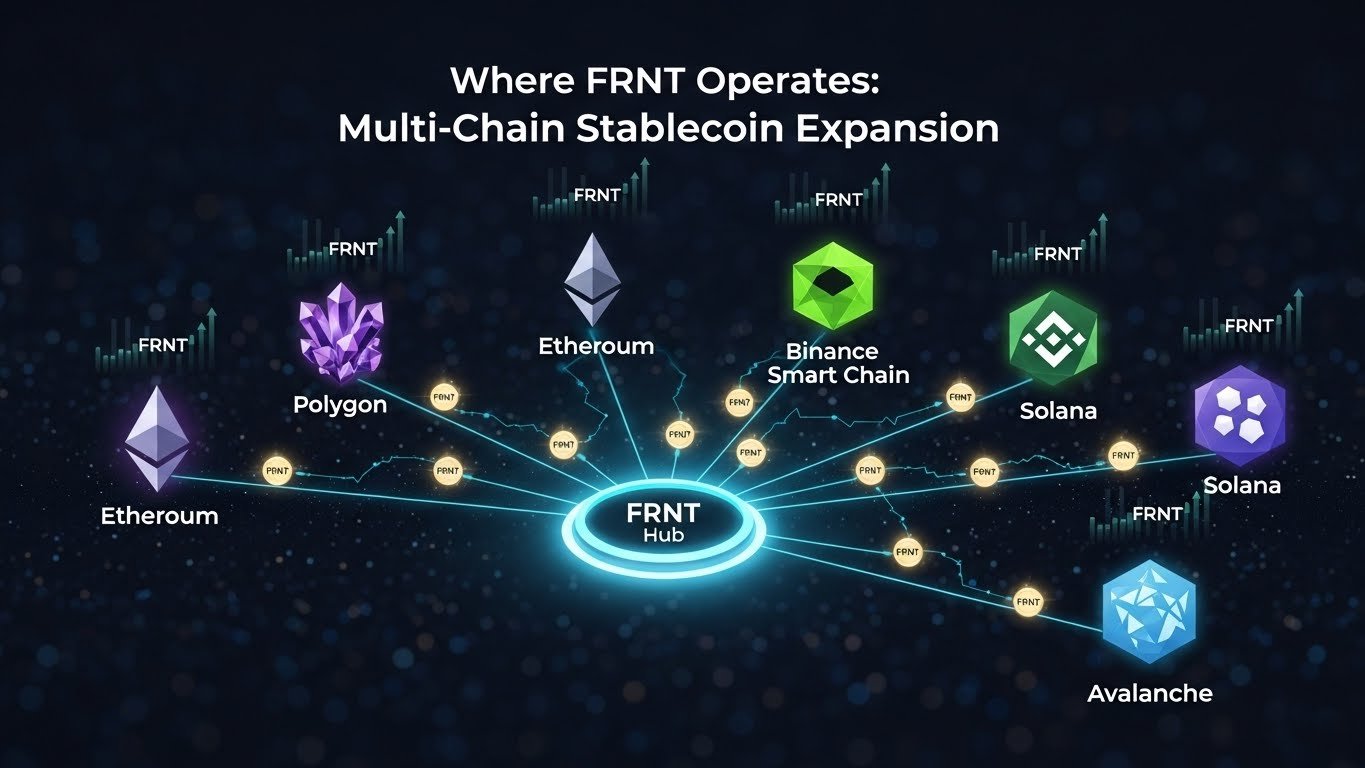
FRNT is designed to operate across multiple blockchains, which increases its usability. Multi-chain availability allows the Frontier Stable Token to move where demand exists, whether that’s on high-speed networks built for payments or on larger ecosystems known for decentralized finance.
Why Multi-Chain Matters for Adoption
Stablecoin success depends heavily on distribution. Users don’t want to buy a stablecoin only to discover it’s not supported by their wallet, exchange, or preferred blockchain. By supporting multiple chains, FRNT reduces friction and increases its chances of being used in real transactions.
Multi-chain support also strengthens resilience. If one network experiences congestion or high transaction fees, users can move to another. This flexibility may become increasingly important as stablecoin usage grows.
Interoperability and Broader Access
Interoperability tools and bridging infrastructure can also help FRNT move between blockchains. While bridges introduce technical complexity, they also unlock greater reach. If managed securely, interoperability could help FRNT integrate into a wide range of crypto applications, exchanges, and payment platforms.
FRNT vs. Private Stablecoins: What Makes It Different?
The stablecoin market today is dominated by private issuers. These stablecoins have massive liquidity and global usage, but they also face ongoing scrutiny related to transparency, reserves, and regulation.
FRNT enters the market with three major distinctions.
A Government-Backed Governance Structure
The most obvious difference is that FRNT is a state issued US stablecoin. This creates a public governance model rather than a purely corporate model. For some users, this could increase trust and reduce concerns around private decision-making.
Conservative Reserves and Institutional Positioning
FRNT emphasizes safe reserves like cash and Treasury assets, which may make it appealing to institutions and cautious users. While some private stablecoins also hold safe reserves, FRNT’s structure is designed to highlight the security and stability of its backing.
Regulatory Identity
FRNT is closely tied to Wyoming’s broader blockchain legislation and compliance vision. That may make it easier to position as a regulated stablecoin compared to stablecoins that must navigate international legal structures or corporate jurisdiction issues.
Use Cases: How People and Businesses Could Use FRNT
For FRNT to succeed, it must be useful. Stablecoins dominate because they solve real problems: they make digital value transfer fast, cheap, and globally accessible.
Digital Payments and Transfers
FRNT can be used for fast digital transfers without relying on banking hours or slow settlement systems. This is especially valuable in situations where traditional transfers are expensive or delayed. Payments are one of the biggest long-term opportunities for stablecoins, and FRNT’s state-issued identity could increase adoption among users who want stablecoin utility with public oversight.
Trading and Crypto Market Liquidity
Stablecoins are critical tools for trading. They act as a “digital cash” layer that allows traders to move in and out of positions quickly. FRNT can function similarly, supporting exchanges and trading strategies while maintaining dollar stability.
Decentralized Finance and Smart Contract Utility
Stablecoins are also essential in decentralized finance. They are used for lending, borrowing, yield generation, and settlement. If FRNT integrates into DeFi ecosystems, it could expand its utility significantly.
The more FRNT becomes part of DeFi platforms, wallets, and payment systems, the more competitive it becomes. That integration is often what separates niche stablecoins from major market players.
Wyoming’s Strategy: Why This State Is Leading Blockchain Adoption
Wyoming did not arrive at FRNT by accident. The state has been building toward this moment through years of blockchain-friendly policy and legal innovation.
Wyoming’s leadership has focused on creating a framework where digital asset companies can operate with clarity. That includes defining digital assets, recognizing blockchain-based records, and supporting new financial structures. This strategy has made the state a natural environment for a public stablecoin experiment.

FRNT is not just about launching a token. It’s about signaling that Wyoming intends to remain a leader in financial innovation. A state issued US stablecoin reinforces that identity and may attract more blockchain builders, fintech startups, and investment.
Potential Challenges for FRNT and State Issued Stablecoins
Even though FRNT is groundbreaking, challenges remain. Stablecoins do not succeed by design alone. They succeed by scale, liquidity, and trust.
Adoption and Competition
The stablecoin market is highly competitive. Established stablecoins have deep liquidity and massive adoption. FRNT must carve out its niche and convince users to adopt it at meaningful scale. This will require partnerships, exchange support, and real-world integrations.
Federal Regulatory Uncertainty
While FRNT is issued under a state framework, stablecoin regulation is also being debated at the federal level. Future federal rules could impact how state-issued stablecoins operate, including requirements for reserves, reporting, and consumer protections. FRNT’s long-term success may depend partly on how national regulation evolves.
Security and Technical Complexity
Multi-chain stablecoins introduce complexity. Supporting multiple networks and interoperability tools increases the number of technical surfaces that must be secured. Smart contract safety, bridge security, and reliable infrastructure are essential. Even a highly credible stablecoin can lose trust quickly if technical issues occur.
What FRNT Could Mean for the Future of Digital Dollars
FRNT represents more than just a new stablecoin. It represents a new way to think about digital dollars.
Traditionally, the U.S. dollar exists as bank deposits, physical cash, and electronic transfers. Stablecoins add a new layer: blockchain-based dollars that can move instantly. The debate has often centered on whether the U.S. should develop a central bank digital currency. Wyoming’s approach suggests that innovation might also come from smaller governments acting locally.
If FRNT succeeds, it could influence how regulators, lawmakers, and the financial industry view stablecoins. It may become a blueprint for how public sector stablecoins can operate alongside private stablecoins, offering users more choice and potentially higher trust standards.
This could also impact how businesses think about settlements, payments, and treasury management. If stablecoins become normalized, the infrastructure of money movement could look very different in the next decade.
Conclusion
Wyoming debuts FRNT as the first state issued US stablecoin, marking a historic step in America’s evolving relationship with digital assets. The Frontier Stable Token stands apart because it combines blockchain efficiency with public oversight, conservative reserves, and a strategic push toward transparency. In a stablecoin market dominated by private issuers, FRNT introduces a new concept: a state-backed stable token designed for real-world use.
Whether FRNT becomes a widely adopted digital dollar or remains a pioneering pilot project, its impact is already meaningful. It demonstrates that governments can move beyond regulation and into innovation, building stablecoin infrastructure that could shape the future of finance. As stablecoin adoption grows globally, FRNT may become one of the most important case studies in how digital money can be issued, governed, and trusted in the United States.
FAQs
Q: What is FRNT?
FRNT, the Frontier Stable Token, is Wyoming’s official stablecoin project designed to maintain a stable value pegged to the U.S. dollar while operating as a blockchain token.
Q: Why is FRNT considered the first state issued US stablecoin?
FRNT is recognized as the first stablecoin launched under a U.S. state governance framework, making it different from privately issued stablecoins and federal CBDC proposals.
Q: How does FRNT stay stable?
FRNT is designed to maintain its dollar peg through full reserve backing, conservative holdings such as cash and Treasury assets, and governance oversight through a state commission structure.
Q: Where can FRNT be used?
FRNT is designed to operate across multiple blockchains, which helps it integrate into payment systems, exchanges, wallets, and potentially decentralized finance platforms.
Q: Will other states issue stablecoins like Wyoming?
It’s possible. If FRNT succeeds, it could inspire other states to explore similar state-backed stablecoin projects, especially as stablecoin regulation and adoption continue to grow.
Also More: Bitcoin Price Stabilizes Near $109K After Surge Ahead
